
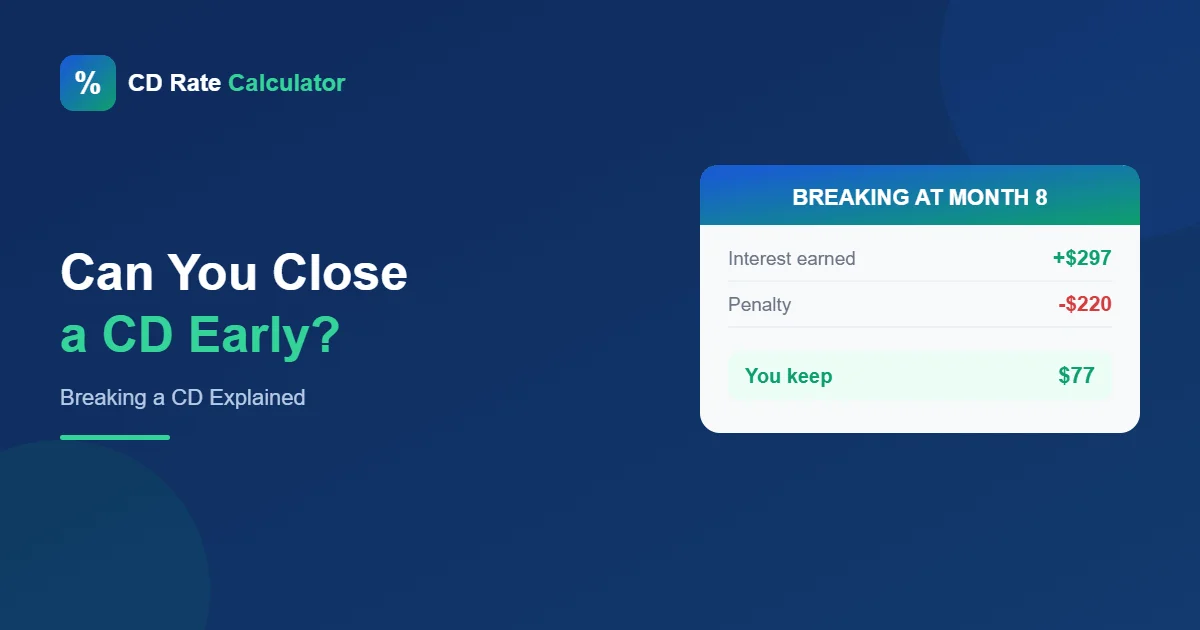
Life changes, and sometimes the money you locked in a CD is suddenly the money you need. The good news: yes, you can get it out. The catch: it usually costs you. Here’s exactly how closing a CD early works, what it costs, and the times it’s actually the smart move.
Quick answer: yes — you can close (break) a CD before maturity anytime, but you’ll typically pay an early withdrawal penalty of 3 to 12 months of interest, depending on the term. You keep your principal minus that penalty. Calculate the exact cost first with our free CD early withdrawal penalty calculator.
How to Close a CD Early
The process itself is simple:
- Contact the bank — online banks usually have a “close CD” option in the app; branch banks may need a call or visit.
- Ask for the exact payout in writing: “What dollar amount will I receive after the penalty?”
- The bank calculates your principal plus interest earned, minus the penalty.
- Funds arrive — usually same-day to a linked account, or 1-3 business days by transfer.
There’s no credit check and no impact on your credit score — a CD is your money, not a loan.
What Does It Cost to Break a CD?
The penalty is almost always a set number of months of interest:
| CD Term | Typical Penalty |
|---|---|
| Under 12 months | 3 months of interest |
| 1–3 years | 6 months of interest |
| 4–5 years | 12 months of interest |
Warning: if you close very early — before you’ve earned enough interest to cover the penalty — the difference comes out of your principal. Breaking a fresh CD can leave you with less than you deposited. Our penalty calculator warns you when that happens.
When Closing a CD Early Is Worth It
- Rates jumped a lot. If new CDs pay far more than your locked rate, the extra interest can out-earn the penalty within months.
- You’d otherwise take high-interest debt. A penalty of a few hundred dollars beats a 25% credit card balance — check with our credit card payoff calculator.
- A genuine emergency with no cheaper source of cash.
Ways to Avoid the Penalty Entirely
- Withdraw only the interest. Earned interest can often be taken out penalty-free — only principal is locked.
- Wait for the grace period. If maturity is close, waiting a few weeks avoids the penalty completely. Check the date with our maturity date calculator.
- Ask about a CD-secured loan. Some banks lend against your CD at a low rate, so it keeps earning while you get cash.
- Use no-penalty CDs next time. They allow one free withdrawal — see our no-penalty CD guide.
A Small Silver Lining
If you do pay a penalty, it’s tax-deductible — reported in Box 2 of your 1099-INT, and it reduces your taxable income even if you take the standard deduction. It doesn’t erase the cost, but it softens it. More in our early withdrawal penalty guide.
FAQ
Can I close a CD before maturity?
Yes, anytime — but you’ll usually pay an early withdrawal penalty of several months’ interest. You keep your principal minus the penalty.
Does breaking a CD hurt my credit?
No. A CD is your own deposit, not a loan, so closing it has zero effect on your credit report.
Can the penalty take my principal?
Yes — if you close before earning enough interest to cover the penalty, the shortfall comes out of your deposit. This mainly happens in a CD’s first months.
Can I close a CD early without any penalty?
Only with a no-penalty CD, during the grace period at maturity, or by withdrawing just the earned interest. Standard CDs charge the penalty otherwise.
How do I know if breaking my CD is worth it?
Compare the penalty against what you’d gain (a higher new rate, or debt avoided). Our penalty calculator shows the exact numbers in seconds.
Before you break any CD, see the exact penalty and what you’d keep — free CD Early Withdrawal Penalty Calculator.