
Locking money in a CD feels safe — until life happens and you need that money before the maturity date. Then you meet the early withdrawal penalty. This guide explains exactly what taking money out of a CD early costs, how the penalty math works, when paying it is actually the smart move, and five ways to avoid it altogether.
Quick answer: most banks charge a penalty equal to several months of interest — typically 3 months on short CDs, 6 months on 1–3 year CDs, and 12 months on longer terms. Calculate your exact cost with our free CD Early Withdrawal Penalty Calculator.
What Is a CD Early Withdrawal Penalty?
A certificate of deposit is a deal: the bank pays you a fixed rate, and you promise to leave the money until maturity. The early withdrawal penalty is the price of breaking that promise. It’s almost always expressed as a number of months of interest, calculated on the amount you withdraw — not a flat fee, and not a percentage of your balance.
Two details people miss:
- The penalty is based on months of interest at your CD’s rate, whether or not you’ve actually earned that much interest yet.
- Most banks charge it on the amount withdrawn. Some allow partial withdrawals (penalty only on the part you take); many require closing the entire CD.
Typical Penalties by CD Term
Every bank sets its own rules, but the market clusters around these numbers:
| CD Term | Typical Penalty |
| Under 12 months | 3 months of interest |
| 12–36 months | 6 months of interest |
| 4–5 years | 12 months of interest |
| Some 5+ year CDs | Up to 24 months of interest |
Always check your specific CD’s disclosure — a few banks charge harsher penalties, and a few calculate them on the full balance rather than the withdrawn amount.
How the Penalty Math Works (Real Example)
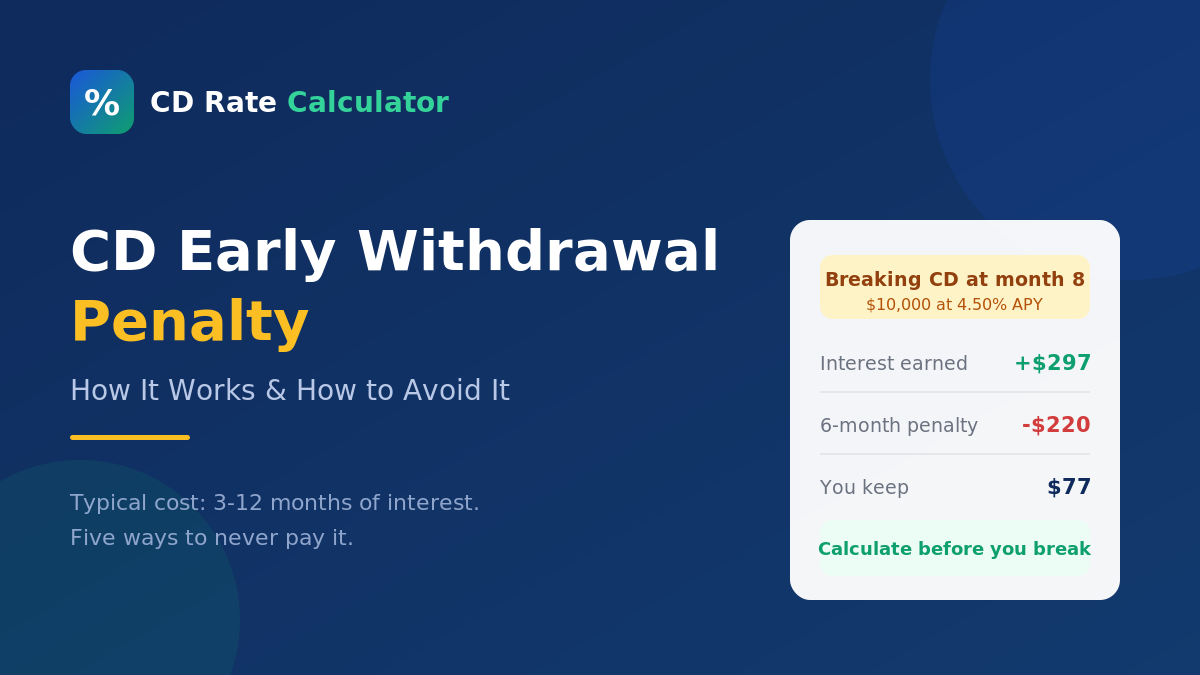
Say you put $10,000 into a 2-year CD at 4.50% APY, and 8 months in, you need the money. Your CD has a 6-month interest penalty.
- Interest earned so far (8 months): about $297.79
- Penalty (6 months of interest): about $220.49
- Net result: you walk away with $10,077.31 — still ahead, but you kept only about a quarter of what you earned.
Now run the same numbers at month 3 instead: you’d have earned about $110, but the penalty is still $220 — meaning $110 comes out of your original deposit. Yes, an early withdrawal penalty can eat into your principal. Our penalty calculator warns you when that happens for your exact numbers.
When Breaking a CD Is Actually Worth It
Paying the penalty isn’t always a mistake. Three situations where the math favors breaking:
- Rates have jumped since you locked. If you’re holding a 2.0% CD with 3 years left and new CDs pay 4.5%, the extra interest from switching can out-earn the penalty within months. Compare: penalty cost vs (new rate − old rate) × balance × remaining years. When the second number is clearly bigger, switch.
- You’re about to take on high-interest debt. Paying an 18-month interest penalty beats carrying a credit card balance at 25% APR. Run the debt side of the math with our Credit Card Payoff Calculator.
- A genuine emergency, with no cheaper source of cash. A penalty of a few hundred dollars is often the least expensive money available on short notice.
The wrong reason to break a CD: impatience, or a rate difference so small the penalty needs years to pay back.
5 Ways to Avoid the Penalty Entirely
- Build a CD ladder instead of one big CD. With money spread across staggered maturities, something is always close to unlocking — you break one small rung at most, not your whole savings. Full walkthrough in our CD Ladder Strategy guide.
- Use no-penalty CDs for uncertain money. These pay slightly less but allow one free withdrawal after the first week. Perfect for “probably won’t need it, but might” funds.
- Never lock your emergency fund. Keep 3–6 months of expenses in a high-yield savings account, and only ladder money above that line — our Emergency Fund Calculator tells you where the line is.
- Match terms to real dates. Money for next year’s tuition belongs in a 12-month CD, not a 5-year one chasing an extra 0.2%. Check exact maturity dates with the CD Maturity Date Calculator.
- Use the grace period. Every maturity gives you a 7–10 day window to withdraw free. Mark it. Money you pull during grace costs nothing; money you pull a month into the auto-renewed CD costs a fresh penalty.
How Penalties Differ by Bank Type
The penalty schedule isn’t standard across the industry, and the differences are worth knowing before you pick a bank:
- Big national banks tend to have the strictest schedules — longer penalty periods, and some calculate the penalty on the entire balance even for partial withdrawals.
- Online banks are usually the most forgiving, with shorter penalty periods and cleaner disclosures. They’re also where no-penalty CDs are most common.
- Credit unions often use tiered penalties (for example, 90 days of dividends on terms under a year, 180 days above) and sometimes cap the penalty at the interest actually earned — meaning your principal is protected. That’s a valuable feature worth asking about directly.
There’s also a federal floor: by regulation, if you withdraw within the first 6 days of opening a CD, the minimum penalty is 7 days of simple interest. Almost every bank charges far more than this minimum, but it’s why even “day one” withdrawals cost something.
The lesson: the penalty policy is as much a part of the deal as the APY. Two CDs at the same rate are not equal if one charges double the exit fee.
The Break-Even Formula for Switching CDs
Thinking of breaking a low-rate CD to grab a better one? Here’s the exact math.
Step 1 — Cost: your penalty in dollars. For a $20,000 CD at 2.0% with a 6-month penalty: $20,000 × 0.02 ÷ 2 = $200.
Step 2 — Gain per year: balance × (new rate − old rate). Moving to 4.5%: $20,000 × (0.045 − 0.02) = $500 per year.
Step 3 — Break-even time: cost ÷ gain per year. $200 ÷ $500 = 0.4 years — you recover the penalty in under 5 months.
If your CD has more time remaining than the break-even period, switching wins. In this example, with 3 years left on the old CD, breaking it earns you roughly $1,300 extra even after the penalty. If the break-even math comes out to longer than the time remaining, stay put.
What Actually Happens When You Break a CD (Step by Step)
The process itself is simple, but knowing it removes the hesitation:
- Contact the bank — online banks usually have a “close CD” option in the app; branch banks may ask you to call or visit.
- Confirm the penalty quote in writing before agreeing. Ask specifically: “What is the exact dollar amount I will receive?”
- The bank calculates: your principal, plus accrued interest, minus the penalty. Any interest already paid out to you (monthly payout CDs) may be clawed back from principal.
- Funds arrive — usually the same day into a linked account at the same bank, or 1–3 business days by transfer elsewhere.
- Keep the paperwork. The penalty appears on your 1099-INT at tax time, and you’ll want the record for your deduction.
One warning: don’t close a CD in anger during a rate promotion at the same bank without asking about an upgrade first. Some banks will let you “bump” to a better rate or restructure without the full penalty — it costs nothing to ask.
Alternatives to Breaking Your CD
Before paying the penalty, check whether one of these gets you the cash cheaper:
- A loan against your CD. Many banks and most credit unions offer CD-secured loans at low rates (often 2–3% above your CD’s rate). Your CD keeps earning, you get liquidity, and if the need is short-term, the loan interest can cost less than the penalty.
- Withdraw only the interest. If your CD has been running a while, accrued interest can often be withdrawn penalty-free — it’s only the principal that’s locked. Ask your bank.
- Borrow from the grace window. If maturity is only a few weeks away, a short-term bridge (even a 0% credit card float) may beat paying months of interest as a penalty.
- Partial withdrawal, if allowed. Taking only what you need keeps the rest earning and shrinks the penalty proportionally.
A Tax Silver Lining
If you do pay a penalty, it’s tax-deductible — and not as an itemized deduction, but as a direct adjustment to income. Your bank reports it in Box 2 of your 1099-INT, and you deduct it even if you take the standard deduction. It doesn’t erase the sting, but it gives a bit back.
FAQ
Does breaking a CD early hurt my credit score?
No. A CD is your money, not a loan — early withdrawal has zero effect on your credit report. The only cost is the penalty itself.
Can the penalty be more than the interest I earned?
Yes. If you withdraw before you’ve earned enough interest to cover the penalty, the difference comes out of your principal. This mainly happens in the first months of a CD’s term.
Can I withdraw just part of my CD?
Depends on the bank. Some allow partial withdrawals with the penalty applied only to the withdrawn amount; many require closing the entire CD. Ask before you open one if this flexibility matters to you.
Are there CDs with no early withdrawal penalty?
Yes — no-penalty CDs (sometimes called liquid CDs) allow one penalty-free withdrawal, usually any time after the first 6–7 days. The trade-off is a slightly lower rate than a standard CD of the same term.
Do IRA CDs have extra penalties?
They can. Breaking the CD triggers the bank’s penalty, and if you’re under 59½, withdrawing the money from the IRA itself may add a 10% IRS penalty plus taxes. Two separate penalties — be careful with retirement CDs.
Will I get back the interest that was already paid to me?
If your CD paid interest out monthly and you break it early, the penalty can exceed your remaining accrued interest — in that case the difference is taken from your principal, which effectively claws back interest you already received. CDs that compound internally simply deduct the penalty from the accumulated balance.
Is the early withdrawal penalty negotiable?
Occasionally, yes. Banks have waived or reduced penalties for long-standing customers, hardship situations (job loss, medical emergency), or when the customer is moving the money into another product at the same bank. It’s never guaranteed, but a polite request costs nothing — especially at credit unions and community banks.
Before you break any CD, spend 30 seconds on our free CD Early Withdrawal Penalty Calculator — see the exact penalty, what you keep, and whether waiting is worth it.