

It’s the most valuable 7-to-10 days in the life of a CD — and most savers don’t even know the clock is running. The grace period is your one free window to make a decision, and missing it hands control to the bank.
Quick answer: a CD’s grace period is the short window — typically 7 to 10 days — right after your CD matures, during which you can withdraw the money, add to it, change the term, or move banks, all with no penalty. Do nothing, and the CD auto-renews. Find your exact maturity date (when the clock starts) with our free CD Maturity Date Calculator.
What the Grace Period Is
When your CD matures, it doesn’t instantly force a decision. Instead the bank gives you a grace period — a brief window when the money is unlocked and fully flexible. Think of it as the CD’s “checkout counter”: your term is done, and before the bank does anything automatic, you get a moment to choose your next move. Every action inside this window is penalty-free.
How Long Is a CD Grace Period?
Most banks offer 7 to 10 calendar days, though the range runs from about 5 to 14 depending on the institution. It’s stated in your CD agreement and the maturity notice the bank sends beforehand. The clock starts on the maturity date itself, and weekends count — so a 7-day grace period that starts on a Friday effectively gives you fewer business days to move money between banks.
What You Can Do During the Grace Period
- Withdraw everything — transfer to checking, savings, or another bank, penalty-free.
- Add money — the one time you can top up a CD before it locks again.
- Change the term — switch from a 1-year to a 5-year, or vice versa.
- Move to a better rate — shop across banks and reinvest wherever pays most. A great moment to start a CD ladder.
- Do nothing — and accept the automatic renewal (usually the worst option).
Why the Grace Period Matters So Much
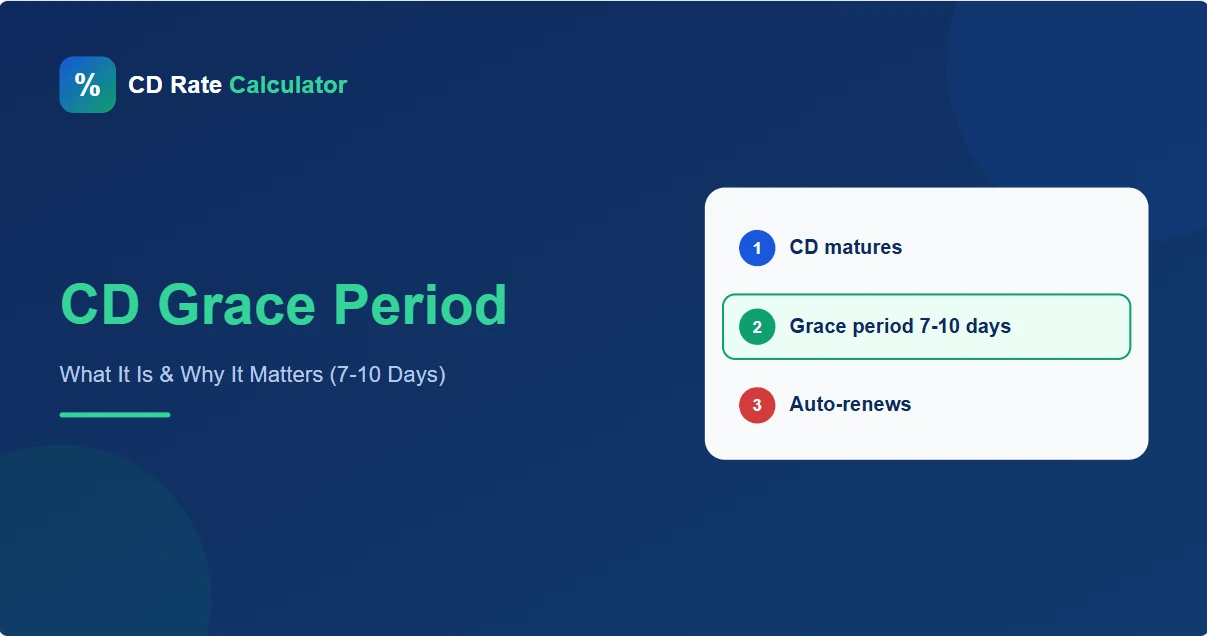
Miss it, and most banks automatically renew your CD into the same term at their current standard rate — often well below the best available — and lock your money again with a fresh early withdrawal penalty. The grace period is the difference between actively choosing your best rate and passively accepting whatever the bank offers. It’s free money protection, and it costs you nothing but a calendar reminder.
How to Never Miss It
The moment you open a CD, put the maturity date in your phone with an alert a week early. When the bank’s maturity notice arrives (usually a few weeks before), spend ten minutes comparing current rates. Then act early in the window — bank-to-bank transfers take 1-3 business days, so don’t wait until day 9 of a 10-day grace period. Our maturity date calculator counts down the days for you.
FAQ
How long is the grace period on a CD?
Usually 7 to 10 calendar days after maturity, ranging from about 5 to 14 depending on the bank. Check your CD agreement for the exact number.
Do I earn interest during the CD grace period?
It varies — some banks pay no interest during grace, others accrue at a low default rate. Either way it’s only a few days, so the bigger money is in choosing the right next step.
Can I withdraw without penalty during the grace period?
Yes — that’s the whole point. Withdrawals, additions, and term changes are all penalty-free during the grace window.
What happens after the grace period ends?
If you did nothing, the CD has auto-renewed into a new term at the current rate, and it’s locked again — withdrawing now means a fresh penalty. See what happens when a CD matures.
Know exactly when your grace period starts — check your maturity date free with the CD Maturity Date Calculator.