
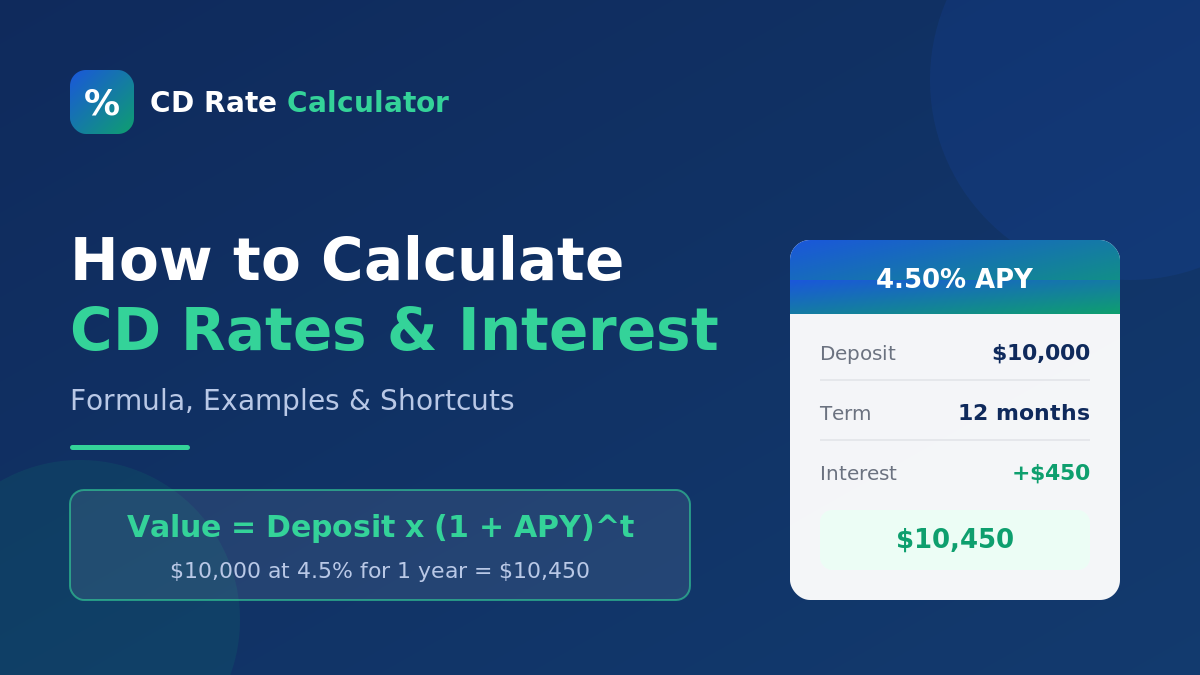
Calculating what a CD will earn takes one formula and thirty seconds. In this guide you’ll learn the exact math banks use, how to calculate CD interest for any term — 3 months to 5 years — how to figure your monthly interest, and the difference between interest rate and APY that trips up almost everyone.
Quick answer: CD Value at Maturity = Deposit × (1 + APY)^(years). Interest earned = that result minus your deposit. A $10,000 CD at 4.50% APY for 1 year earns $450. Don’t want to do the math by hand? Use our free CD Rate Calculator — it does this instantly.
The CD Interest Formula, Explained
Banks advertise CD rates as APY (annual percentage yield), and that’s the number that makes the math easy. APY already includes compounding, so the full formula is:
Maturity Value = Deposit × (1 + APY)^t
Where:
- Deposit = the amount you put in
- APY = the advertised rate as a decimal (4.50% = 0.045)
- t = the term in years (6 months = 0.5, 18 months = 1.5)
Then simply: Interest Earned = Maturity Value − Deposit.
Step-by-Step Example
Let’s calculate a $10,000 CD at 4.50% APY for 1 year:
- Convert the APY to a decimal: 4.50% → 0.045
- Add 1: 1.045
- Raise it to the term in years: 1.045^1 = 1.045
- Multiply by your deposit: $10,000 × 1.045 = $10,450
- Subtract the deposit: $10,450 − $10,000 = $450 interest
That’s the entire calculation. The exponent only matters when your term isn’t exactly one year — which is where most people slip, so let’s do those.
Calculating CD Interest for Any Term
3-month CD (t = 0.25): $10,000 × 1.045^0.25 = $10,110.65 → about $110.65 interest
6-month CD (t = 0.5): $10,000 × 1.045^0.5 = $10,222.52 → about $222.52 interest
18-month CD (t = 1.5): $10,000 × 1.045^1.5 = $10,682.31 → about $682.31 interest
5-year CD (t = 5): $10,000 × 1.045^5 = $12,461.82 → about $2,461.82 interest
Notice the 5-year number: it’s more than 5× the 1-year interest ($450 × 5 = $2,250). That extra $212 is compounding — each year’s interest earning its own interest. The longer the term, the more compounding works for you.
Want these numbers for your own deposit and rate? Our CD Rate Calculator handles any amount, rate, and term from 3 to 60 months.
How to Calculate CD Interest Per Month
If your CD pays interest out monthly (common for retirees who want income), the monthly payment is:
Monthly Interest = Deposit × ((1 + APY)^(1/12) − 1)
For a $10,000 CD at 4.50% APY: $10,000 × 0.003675 = about $36.75 per month. On a $100,000 deposit, that’s roughly $367 in monthly income. Run your own numbers with our CD Monthly Payout Calculator.
One caveat: taking interest out monthly means it never compounds, so your total earnings land slightly below the advertised APY. That’s not a trick — it’s just how compounding works.
Interest Rate vs APY: Don’t Mix Them Up
Banks quote two numbers, and they’re not the same:
- Interest rate (APR / nominal rate): the base rate before compounding
- APY: what you actually earn in a year, with compounding included
A CD with a 4.40% interest rate compounded daily produces a 4.50% APY. When comparing CDs, always compare APY to APY — it’s the only apples-to-apples number. If a bank only gives you the nominal rate, convert it with our APY to APR Calculator.
Credit union note: credit unions call interest a “dividend” and quote a “dividend rate” — mathematically it works exactly the same way. Their APY equivalent is called APY too, so compare that number.
How to Calculate CD Interest in Excel or Google Sheets
If you want to run many scenarios at once, a spreadsheet does the same math with one function. In any cell, type:
=10000*(1+0.045)^1
Replace 10000 with your deposit, 0.045 with your APY as a decimal, and 1 with your term in years. For a 30-month CD at 4.25% on $25,000, you’d write =25000*(1+0.0425)^2.5 and get $27,760 back.
Excel also has a built-in future value function that works for CDs:
=FV(0.045, 1, 0, -10000)
The format is FV(rate, periods, payment, -deposit). Keep the payment at 0 (you don’t add money to a CD after opening) and enter your deposit as a negative number. Both methods give identical answers — use whichever feels natural. And if you’d rather not open a spreadsheet at all, our free CD Rate Calculator does it in one click.
Simple Interest vs Compound Interest on CDs
A common confusion: some people calculate CD earnings with simple interest — Deposit × Rate × Years — and wonder why their bank’s numbers look different.
Simple interest on $10,000 at 4.5% for 5 years would be $10,000 × 0.045 × 5 = $2,250. But CDs pay compound interest, which reinvests each period’s earnings, producing $2,462 over the same 5 years — $212 more.
The two methods only match for terms of exactly one year. For anything longer, simple interest underestimates your earnings; for anything shorter, it slightly overestimates them. The rule is easy to remember:
- 1 year exactly: simple math works fine (deposit × APY)
- Longer than 1 year: always use the compound formula — the gap grows every year
- Shorter than 1 year: use the compound formula with a fractional exponent for the precise number
This is also why comparing a CD to a loan or a bond using simple math can mislead you — always compare compound to compound.
Worked Example: Comparing Two Real CD Offers
Let’s use the formula to make an actual decision. Suppose you have $15,000 and two offers:
- Bank A: 12-month CD at 4.60% APY
- Bank B: 18-month CD at 4.35% APY
Bank A: $15,000 × 1.046^1 = $15,690 → $690 interest in 12 months. Bank B: $15,000 × 1.0435^1.5 = $15,977 → $977 interest in 18 months.
Bank B earns more in total, but it also holds your money 6 months longer. To compare fairly, look at the per-year rate — which is exactly what APY is. Bank A’s 4.60% beats Bank B’s 4.35% per year. So the real question isn’t the math; it’s whether you believe rates will be higher or lower in 12 months when Bank A’s CD matures.
If you expect rates to fall, the longer CD at a slightly lower APY can still be the smarter lock. If you expect rates to rise, take the higher short-term APY and re-shop at maturity. This is also exactly the problem a CD ladder solves — you don’t have to guess. Read our complete CD Ladder Strategy guide to see how.
How Banks Set CD Rates (the Other Meaning of “Calculated”)
If you’re wondering how banks decide what rate to offer in the first place: CD rates track the Federal Reserve’s benchmark rate, the bank’s need for deposits, and competition. When the Fed raises rates, CD rates climb within weeks; when cuts are expected, banks trim long-term CD rates first. That’s why the best available rate changes constantly — and why it pays to compare several banks every time a CD matures.
Calculating Your Real Return: Taxes and Inflation
Two things quietly shrink your CD earnings:
- Taxes: CD interest is taxed as ordinary income the year it’s credited. In a 22% bracket, that $450 of interest is really $351 after tax. Inside an IRA, tax is deferred — see the difference with our IRA CD Calculator.
- Inflation: if your CD pays 4.5% and inflation runs 3%, your real purchasing-power gain is roughly 1.5%. A CD protects money; it rarely grows wealth dramatically.
FAQ
What’s the formula to calculate CD interest?
Maturity Value = Deposit × (1 + APY)^years. Subtract your deposit from the result to get the interest earned.
How do I calculate the rate of return on a CD?
If you know the start and end values: Rate of Return = (Ending Value ÷ Deposit)^(1 ÷ years) − 1. A CD that grew $10,000 to $12,462 over 5 years returned (1.2462)^0.2 − 1 ≈ 4.5% per year.
How is interest calculated on a 3-month CD?
Same formula with t = 0.25. At 4.5% APY, $10,000 earns about $110.65 in 3 months. Short CDs earn proportionally less because compounding barely gets started.
Does a CD calculate interest daily or monthly?
It varies by bank — daily compounding is most common. But because APY already bakes in the compounding schedule, you don’t need to know it to calculate your earnings. Two CDs with the same APY pay the same, regardless of compounding frequency.
How do I calculate CD interest after taxes?
Multiply your interest by (1 − your tax bracket). $450 of interest at a 24% bracket: $450 × 0.76 = $342 kept.
Can I calculate CD interest without knowing the compounding frequency?
Yes — that’s the whole point of APY. Because APY already includes the effect of compounding, the formula Deposit × (1 + APY)^years gives the correct answer no matter how often the bank compounds. You only need the compounding schedule if you’re working from the nominal interest rate instead.
How much does $50,000 earn in a 5-year CD?
At 4.5% APY: $50,000 × 1.045^5 = $62,309 — about $12,309 in guaranteed interest. At 4% APY the same CD earns $10,833. That $2,000+ difference from half a percent is why comparing rates before locking a large deposit matters so much.
Skip the hand math — enter your deposit, rate, and term into the free CD Rate Calculator and get your maturity value instantly.