
One month a bank offers 5% on a CD; a year later the same bank offers 3.5%. Nothing about the bank changed — so what actually moves CD rates? Understanding the answer tells you when to lock, when to wait, and why the rate you’re offered today won’t last.
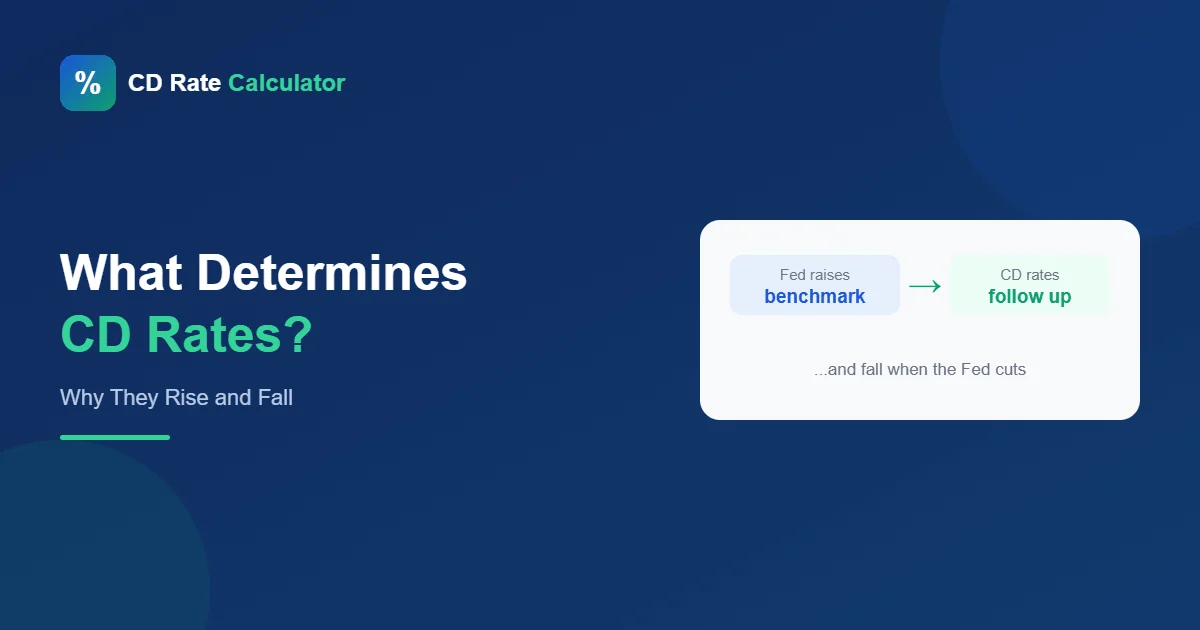
Quick answer: CD rates are driven mainly by the Federal Reserve’s benchmark interest rate. When the Fed raises rates, CD rates climb within weeks; when it cuts, they fall. On top of that, a bank’s need for deposits and the term length fine-tune the exact rate you’re offered. See what any rate earns with our free CD rate calculator.
1. The Federal Reserve (the Biggest Factor)
The Fed sets the federal funds rate — the rate banks charge each other for overnight loans. It’s the anchor for nearly every short-term rate in the economy, including CDs.
When the Fed hikes to fight inflation, banks can earn more lending money, so they raise CD rates to attract deposits.
When the Fed cuts to support the economy, CD rates drop.
This is why CD rates moved from near-zero in 2021 to 5%+ in 2023 — the Fed’s fastest hiking cycle in decades. Track the pattern in our historical CD rates guide.
2. The Bank’s Need for Deposits
Banks fund their lending with deposits. A bank aggressively growing its loan book needs cash, so it offers above-market CD rates to pull it in.
A bank already flush with deposits has no reason to compete, so it pays the bare minimum.
This is why online banks usually beat brick-and-mortar banks — they have lower costs and often want deposits more, so they pass higher rates to you. It’s also why shopping around can find a rate a full percentage point above the national average.
3. The Term Length
Normally, longer terms pay higher rates — the bank rewards you for committing money longer. But not always.
When markets expect the Fed to cut soon, banks sometimes pay more on short CDs than long ones (an “inverted” curve), because they don’t want to lock in high rates for years.
That’s why a 6-month CD occasionally beats a 5-year CD — the market is pricing in future cuts. Compare terms with our CD comparison calculator.
4. Promotions and Odd Terms
Banks use non-standard terms — 7, 9, 11, 13 months — for promotional offers to attract new money. These promos often beat the bank’s own standard rates, but they usually renew into a mediocre standard term, so watch the auto-renewal.
Why Are CD Rates “So Low” (or High)?
It depends entirely on your reference point. Compared to the 2010s (near zero), today’s mid-4% rates are excellent. Compared to 1981 (17%+), they’re modest.
The honest measure is the rate minus inflation — a 4.5% CD against 3% inflation gives a ~1.5% real return, which is historically respectable. When people say rates are “low,” they’re often comparing to a recent peak, not to history.
What This Means for You
- When rates look historically high, lock longer. A 5-year CD freezes today’s rate through future cuts — see the 5-year CD calculator.
- When rates are rising, stay shorter so you can reprice at maturity.
- When you can’t predict (usually), build a ladder. A CD ladder averages you across the cycle so you never have to guess the Fed.
- Always shop banks. The single biggest rate difference you control isn’t timing the Fed — it’s picking a bank that actually wants your deposit.
FAQ
Why are CD rates dropping?
Usually because the Federal Reserve is cutting or expected to cut its benchmark rate. Banks lower CD rates in step, often before the Fed even acts, once cuts are anticipated.
Will CD rates go up in 2026?
That depends on Fed policy, which tracks inflation and the economy. No one reliably predicts it — which is exactly why laddering beats trying to time it.
Why do online banks have higher CD rates?
Lower overhead and a stronger appetite for deposits. They pass those savings to you as higher APYs, often a full point above traditional banks.
Do all banks offer the same CD rates?
No — rates vary widely for the identical term and insurance. Shopping across banks is the highest-value few minutes in CD investing.
Whatever today’s rate is, see what it earns on your deposit — free CD Rate Calculator.