
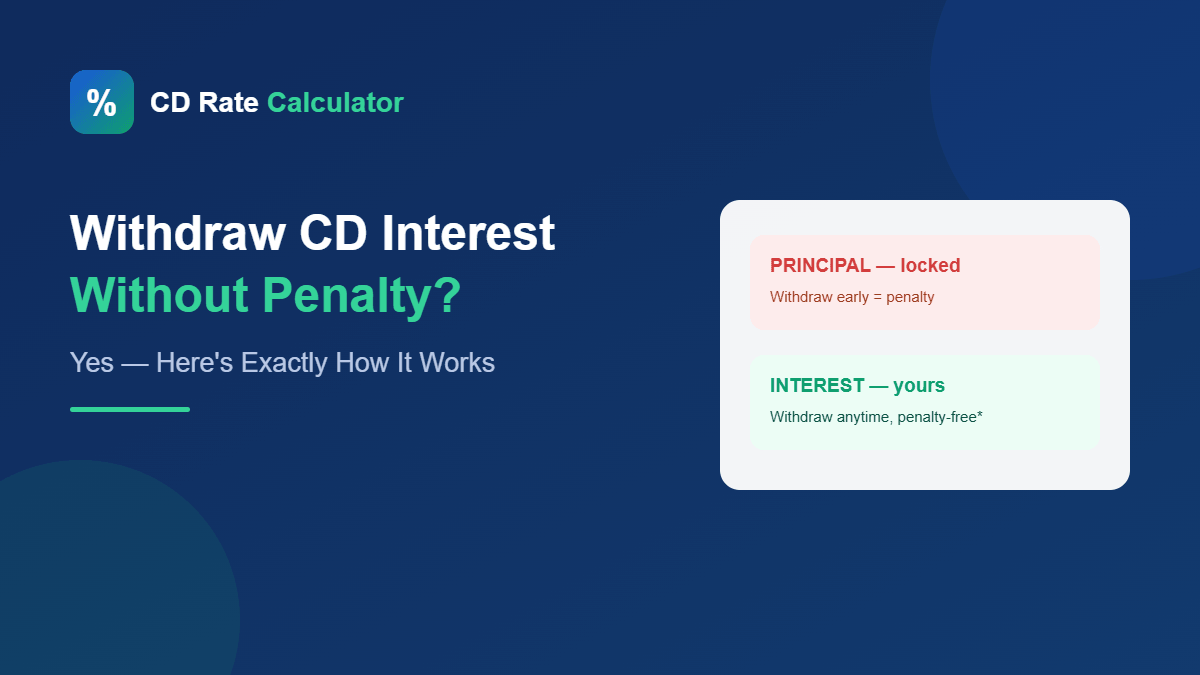
Here’s a CD rule almost nobody explains clearly: the early withdrawal penalty protects the bank’s claim on your principal — not on the interest you’ve already earned. At most banks, that earned interest is yours to take, penalty-free, whenever you want. Let’s unpack how that works, what it quietly costs, and the situations where it’s the right move.
Quick answer: yes — most banks let you withdraw earned interest from a CD at any time without penalty; only the original deposit is locked until maturity. Many will even send the interest to your checking account automatically each month. See what that income looks like with our CD monthly payout calculator.
Principal vs Interest: The Line That Matters
When you open a CD, your deposit (the principal) is what the term and penalty apply to. Interest is different — once it’s been credited to the CD, most bank agreements treat it as withdrawable. Take out $200 of earned interest and there’s no penalty; take out $200 of principal and the penalty machinery kicks in. The bank’s own paperwork calls this “withdrawal of credited interest,” and it’s standard at the large majority of banks — though not universal, so confirm in your CD’s disclosure before counting on it.
Two Ways to Take the Interest
- Automatic interest payouts. Set up at opening: the CD pays its interest to a linked account monthly or quarterly, forever. Clean, effortless, and popular with retirees living on CD income — a $100,000 CD at 4.50% APY produces about $367 a month this way.
- Ad-hoc withdrawals. Leave the CD compounding normally, and pull accumulated interest only when you want it — after a year, you could take out everything the CD has earned so far and leave the principal untouched to keep working.
The Cost of Taking Interest Out

Penalty-free doesn’t mean cost-free. Interest you remove stops compounding — and compounding is where a CD’s quiet magic lives.
On a $10,000 CD at 4.50% for 5 years: leave everything in, and you finish with about $2,462 of interest. Withdraw the interest every year, and you collect 5 × $450 = $2,250. The $212 difference is the compounding you gave up — about 9% of your total earnings. On bigger deposits and longer terms, the gap widens. So the honest framing: withdrawing interest is a fair trade when you need the income, and a silent leak when you’re just nibbling.
When It Makes Sense
- Retirement income: predictable monthly interest without touching principal — the classic use.
- Covering the CD’s own taxes: interest is taxed yearly even if you don’t withdraw it; some savers pull just enough each year to pay the tax bill.
- Bridging a small cash gap: withdrawing $300 of earned interest beats breaking the whole CD and paying a penalty on principal.
When It Doesn’t
If you don’t need the income, leave it alone — you bought the APY, and the APY assumes compounding. And if you find yourself regularly raiding the interest, the real problem is that this money wasn’t ready to be locked: consider a smaller CD next time plus a bigger liquid buffer (our emergency fund guide covers the split).
FAQ
Can I withdraw interest from any CD?
Most standard bank CDs allow it, but not all — a minority credit interest in ways that lock it with the principal. The phrase to find in your disclosure is whether credited interest may be withdrawn “without penalty.”
Does withdrawing interest reduce my APY?
Your rate stays the same, but your realized earnings land slightly below the advertised APY, because APY assumes interest stays in and compounds.
Is withdrawn CD interest taxable?
Yes — but no more than usual. CD interest is taxed in the year it’s credited whether you withdraw it or not, so taking it out creates no extra tax.
Can I withdraw interest from an IRA CD the same way?
Careful — inside an IRA, pulling interest out of the account counts as an IRA withdrawal, with its own tax rules and possible penalties before 59½. The bank may waive its penalty; the IRS won’t. See our CD vs IRA guide.
Want interest as monthly income? See exactly what your deposit would pay with the free CD Monthly Payout Calculator.