
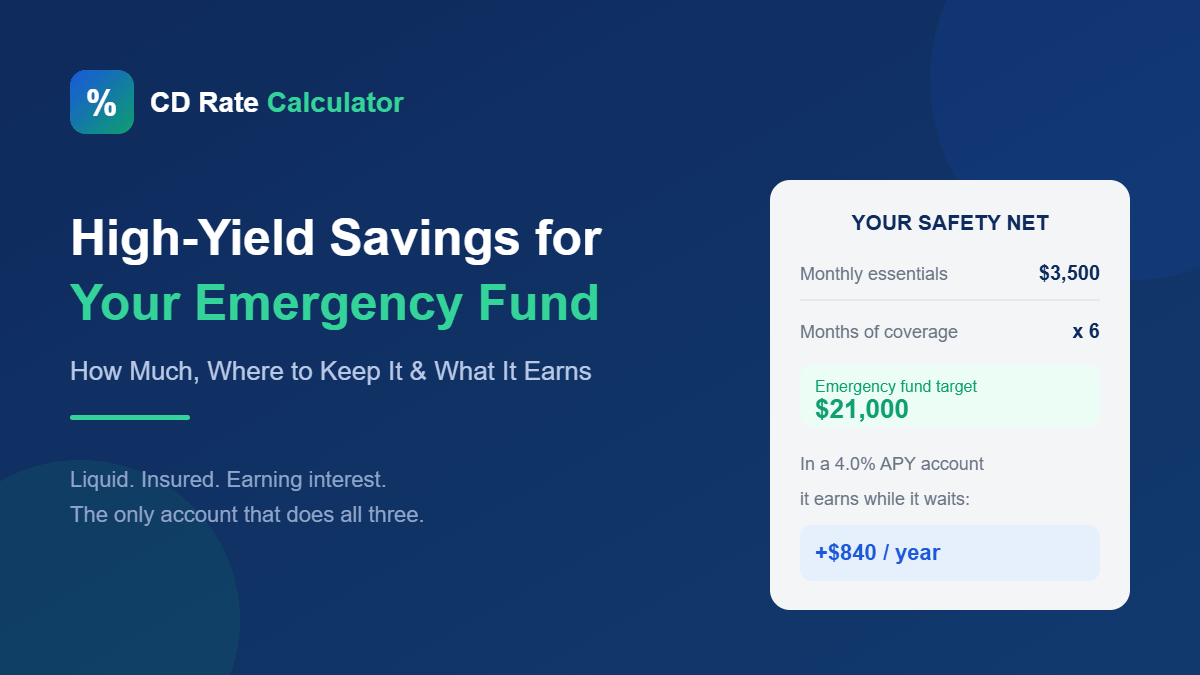
An emergency fund has one job: be there, in full, the moment life goes wrong. That job description rules out most places you could put money — and points almost perfectly at one: the high-yield savings account (HYSA). This guide explains why, how much to keep there, what actually matters when choosing an account, and the tiered setup that squeezes extra interest out of a big fund without risking access.
Quick answer: keep 3-6 months of essential expenses in a high-yield savings account — liquid, FDIC-insured, and earning real interest. Find your exact target number with our free Emergency Fund Calculator.
Why a High-Yield Savings Account Wins for Emergency Money
Test any account against the three things an emergency fund must do, and the HYSA is the only one that passes all three:
- Instant access. Emergencies don’t give notice. HYSA money transfers out same-day or overnight — no maturity dates, no penalties, no selling anything.
- Zero risk to principal. HYSAs at FDIC-insured banks are protected up to $250,000 per depositor. The balance can only go up.
- Meaningful interest. Unlike a checking account paying nothing, a competitive HYSA pays real interest — on a $15,000 fund at 4.0% APY, that’s about $600 a year for doing absolutely nothing.
Checking accounts fail the third test. CDs fail the first. Stocks fail the second — a market crash and a job loss love to arrive together, which is precisely when you’d be selling at a loss.
How Much Should Be in It?
The standard answer is 3 to 6 months of essential expenses — rent or mortgage, food, utilities, insurance, minimum debt payments. Not your full lifestyle spending, just the survival number.
Where you land in that range depends on income stability:
- 3 months: two stable incomes in the household
- 6 months: single income, or one stable + one variable
- 9-12 months: freelancers, commission earners, volatile industries
If your essential expenses are $3,500 a month, your target is $10,500 to $21,000. Run your own numbers — including how long it’ll take to get there at your savings rate — with the Emergency Fund Calculator.
What to Look For in a High-Yield Savings Account
Rates get all the attention, but four other features matter as much for emergency money:
- A consistently competitive APY — not necessarily the single highest. Banks that top the rate tables with promotional spikes often drift down later. A bank that stays near the top beats one that visits it.
- No monthly fees and no minimum balance. Any fee on an emergency fund is a leak. Plenty of excellent accounts charge nothing — accept nothing less.
- Fast, free transfers to your checking account. Test it after opening: move $100 out and time it. Same-day or next-day is the standard you want.
- FDIC insurance (or NCUA at credit unions). Non-negotiable. Check the bank on fdic.gov if you’ve never heard of it — many of the best HYSA rates come from legitimate online-only banks.
One thing that doesn’t matter much: ATM access. Real emergencies are paid by transfer or card, not cash from a machine.
The Tiered Emergency Fund: Earn More Without Losing Access

Once your fund passes about 3 months of expenses, you can structure it to earn more:
- Tier 1 — First month of expenses: high-yield savings. Instant access for the emergencies that actually happen — car repairs, medical bills, urgent travel.
- Tier 2 — Months 2-3: still HYSA, or a money market account if you find a better rate (compare with our Money Market Calculator).
- Tier 3 — Months 4-6+: this money is for a job loss, which unfolds over weeks, not hours. A no-penalty CD or a short CD ladder here earns CD-level rates while staying reachable within days.
The math: on a $21,000 fund, moving the last $10,000 from a 4.0% HYSA into 4.5% CDs earns an extra $50 a year — modest, but free, and it compounds every year your fund sits untouched. Compare the exact gap for your balance with the CD vs High-Yield Savings Calculator.
Mistakes That Quietly Break Emergency Funds
- Keeping it in checking. Zero interest, and worse — money you see daily gets spent. Separation is a feature.
- Locking all of it in CDs. The rate is tempting, but a 6-month penalty on the exact day you need the money defeats the purpose. CDs are for Tier 3 only.
- Investing it. Historically markets have gone up over years — but your emergency is next month, not next decade. This money’s job is existing, not growing.
- Never restarting after using it. Spent $4,000 on a car transmission? That’s the fund working. The mistake is not rebuilding — set the auto-transfer again the same week.
- Letting it overflow. Past 6-12 months of expenses, extra cash is losing to inflation. Redirect the surplus toward retirement or other goals with our Savings Goal Calculator.
FAQ
Is a high-yield savings account safe for an emergency fund?
Yes — at an FDIC-insured bank, deposits are federally protected up to $250,000 per depositor, per bank. An online bank with FDIC insurance is exactly as safe as a branch bank for your money.
Can I use a money market account instead?
Absolutely — MMAs are FDIC-insured and equally liquid, sometimes with check-writing. Choose whichever pays more at your balance; the differences are small. Watch for minimum-balance requirements on MMAs.
Should I keep my emergency fund at the same bank as my checking?
A different bank has two advantages: the best HYSA rates are usually at online banks, and the one-day transfer delay adds a useful speed bump against impulse spending. Keep them linked for fast transfers.
How much interest will my emergency fund earn?
At 4.0% APY: $10,000 earns about $400 a year; $20,000 about $800. Interest is taxable as ordinary income, and rates float with the market — recheck your rate a couple of times a year.
Should part of my emergency fund be in CDs?
Only the deep end — money beyond your first 2-3 months of expenses — and ideally in no-penalty CDs or a short ladder so something is always close to maturity. Never the whole fund.
Find your exact emergency fund target — and how long it’ll take to build — with the free Emergency Fund Calculator.