
When you want a safe home for cash — not the stock market — three names come up: certificates of deposit, Treasury bills, and bonds. They look similar from a distance, but the differences in taxes, access, and risk decide which one actually fits your money. Here’s the honest comparison.
Quick answer: a CD locks a fixed rate at a bank with FDIC insurance; a Treasury bill is short-term government debt that’s state-tax-free; a bond is longer-term debt (government or corporate) that pays regular interest but can lose value if sold early. For most savers with a set timeline, a CD or T-bill wins; bonds suit longer horizons. Compare a CD and T-bill on the same money with our Treasury bill calculator.
The Three at a Glance
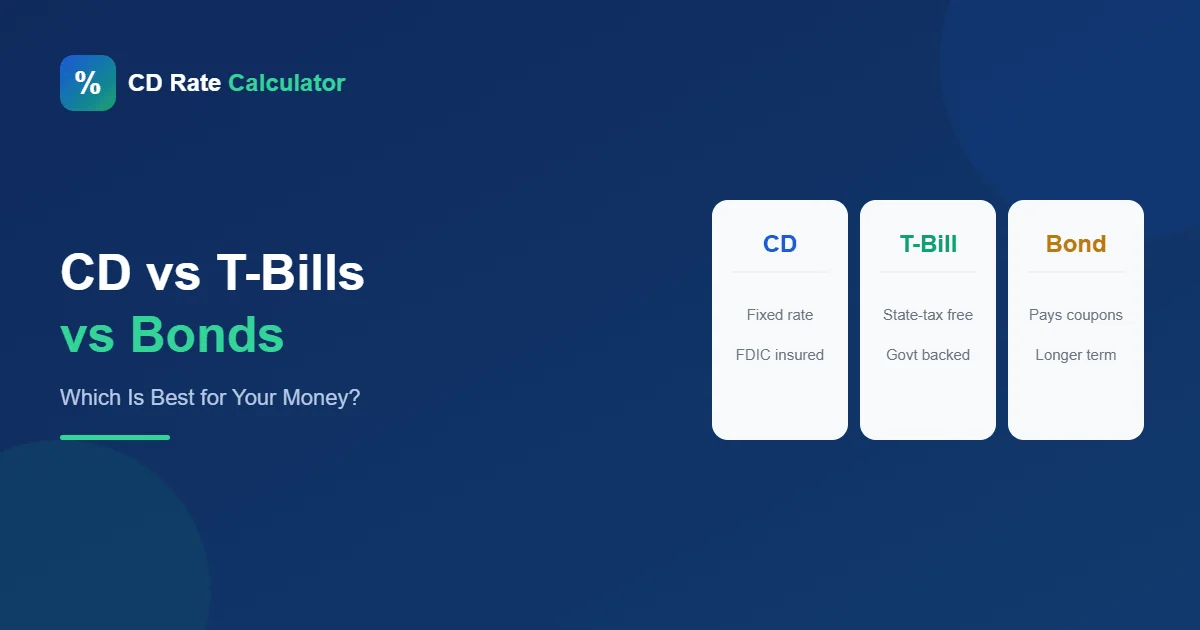
| CD | Treasury Bill | Bond | |
|---|---|---|---|
| What it is | Bank deposit, fixed term | Short-term govt debt (≤1 yr) | Longer-term debt (govt/corporate) |
| Typical term | 3 months – 5 years | 4 weeks – 52 weeks | 2 – 30 years |
| Safety | FDIC-insured to $250k | Backed by U.S. government | Varies (govt safe, corporate riskier) |
| State tax on interest | Taxed | Exempt | Govt exempt; corporate taxed |
| Early exit | Penalty (months of interest) | Sell on market (price varies) | Sell on market (price varies) |
| Best for | Fixed-date, zero-risk savings | Short-term cash, high-tax states | Long-term income |
Certificates of Deposit (CDs)
A CD is the simplest of the three: deposit money at a bank for a fixed term, earn a locked rate, and get your principal plus interest at maturity. It’s FDIC-insured up to $250,000, so there’s zero risk to principal if held to maturity. The catch is the early withdrawal penalty if you need the money sooner. CDs shine when you have a known future date and want certainty — see our full guide on how CDs work.
Treasury Bills (T-Bills)
T-bills are short-term debt issued by the U.S. government, sold at a discount: you might pay $978 for a bill that pays $1,000 in six months. The $22 difference is your interest. Two big advantages over CDs: the interest is exempt from state and local income tax (a real edge in high-tax states), and you can sell before maturity on the open market instead of paying a fixed penalty. The trade-off is that if you sell early, the price you get depends on the market. Calculate T-bill yield with our Treasury bill calculator.
Bonds

Bonds are longer-term debt — you lend money for years and receive regular interest payments (coupons), then your principal back at maturity. Government bonds (Treasury notes and bonds) are very safe; corporate bonds pay more but carry the issuer’s risk. The key difference from CDs: a bond’s market price moves opposite to interest rates, so if you sell before maturity when rates have risen, you can lose money. Bonds suit investors with long horizons who want income and can hold through rate swings.
How to Choose
- Money you’ll need on a set date, want zero risk: a CD — match the term to the date.
- Short-term cash, especially in a high-tax state: a T-bill — the state-tax exemption often beats a CD’s slightly higher rate. Compare after-tax.
- Long-term income, can tolerate price swings: bonds — or a bond fund for diversification.
- Can’t decide between CD and T-bill: run both through the numbers. Our comparison tools and the T-bill calculator make it a two-minute check.
The Tax Angle That Changes the Math
This is where many savers pick wrong. A 4.4% T-bill can beat a 4.6% CD after tax if you live in a high-tax state, because T-bill interest escapes state tax. In a no-income-tax state (Texas, Florida), that edge disappears and the higher headline rate wins. Always compare after-tax returns, not headline rates — and remember all three are taxed federally.
FAQ
Is a CD or Treasury bill safer?
Both are extremely safe. CDs are FDIC-insured up to $250,000; T-bills are backed by the full faith of the U.S. government with no dollar limit. For amounts under $250k, they’re equally safe.
Are Treasury bills better than CDs?
Often for short-term money in high-tax states, because T-bill interest is state-tax-free and they’re easier to sell early. CDs can win on headline rate and simplicity. Compare after-tax.
Do bonds lose money like stocks?
Not the same way — held to maturity, a government bond returns your principal. But if you sell early after rates rise, the market price can be below what you paid. That’s the main risk versus a CD.
Which pays the most right now?
It varies week to week and by term. Calculate the CD with our CD rate calculator and the T-bill with the Treasury bill calculator, then compare after-tax.
Compare a CD and a Treasury bill on the same money — free Treasury Bill Calculator and CD Rate Calculator.