
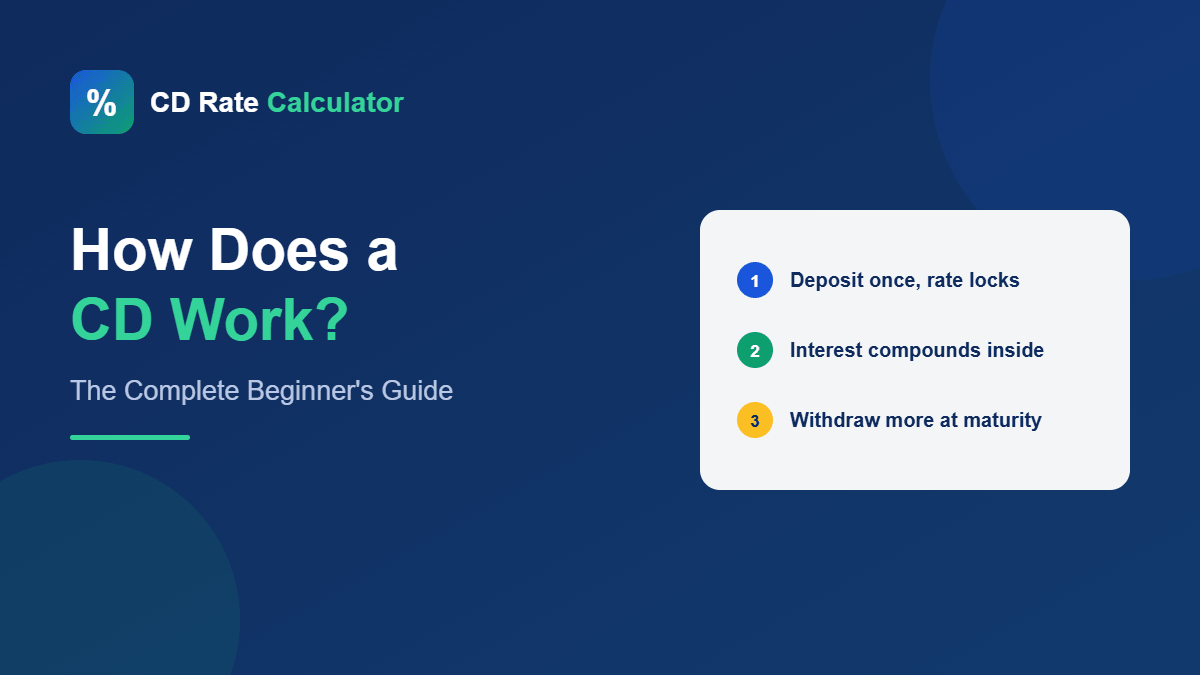
A certificate of deposit is the simplest deal in banking: you lend the bank your money for a fixed time, and the bank pays you a fixed, guaranteed rate for it. No market swings, no surprises, no fees — just a locked agreement. Here’s exactly how a CD works at a bank, from opening day to maturity, in plain English.
Quick answer: you deposit a lump sum for a set term (3 months to 5+ years) at a locked APY. The money stays untouched until the term ends; withdraw early and you pay a penalty of several months’ interest. At maturity you get your deposit plus all the interest — see your exact numbers with our free CD rate calculator.
The Deal in One Paragraph
Banks make money by lending. Your CD deposit gives the bank stable, predictable funds to lend — and in exchange for promising not to withdraw it, you get a higher rate than a regular savings account pays, locked for the whole term. That’s the entire economics of a CD: your commitment is literally what you’re being paid for.
Opening a CD, Step by Step

- Pick a term. From 3 months to 5 years at most banks (longer via brokerages). Match the term to when you’ll actually need the money — our term-specific calculators show earnings for every option.
- Compare APYs across banks. Rates for the same term vary enormously — online banks frequently pay a full percentage point more than branch banks. This ten-minute comparison is the highest-paid work in personal finance.
- Deposit once. CDs take a single opening deposit — most don’t allow additions later. Minimums range from $0 to $1,000 at typical banks.
- Rate locks instantly. From that moment, market moves don’t affect you. The APY on your paperwork is the APY you get.
While the CD Runs
Honestly: nothing happens, and that’s the point. Interest accrues (usually daily) and compounds inside the CD — each month’s interest starts earning its own interest. A $10,000 CD at 4.50% APY quietly becomes $10,450 over a year without a single action from you. Some CDs offer a monthly interest payout instead, popular with retirees who want income.
The one rule: don’t touch the principal. Withdrawing before maturity triggers an early withdrawal penalty — typically 3 months of interest on short CDs and 6-12 months on longer ones. Our penalty calculator shows exactly what breaking a CD would cost.
At Maturity: The Part Everyone Gets Wrong
When the term ends, your money unlocks — and a grace period of about 7-10 days begins. In that window you can withdraw everything, add money, switch terms, or move banks, all penalty-free.
Miss the window, and most banks auto-renew your CD for the same term at their current standard rate — often much lower than what good banks pay. This is the single most expensive CD mistake, and the fix is a phone reminder. Full details in our guide on what happens when your CD matures.
Is Your Money Safe in a CD?
Yes — this is the CD’s superpower. Deposits at FDIC-insured banks are federally protected up to $250,000 per depositor, per bank (NCUA provides the same at credit unions). If the bank fails, you’re made whole. Combined with the locked rate, a CD held to maturity has exactly zero ways to lose a dollar of principal.
CD vs Savings Account: The One-Line Difference
A savings account is flexible money at a floating rate; a CD is committed money at a locked, usually higher rate. Flexible money belongs in savings; money with a date on it belongs in a CD. Compare the same deposit both ways with our CD vs high-yield savings calculator — and if you can’t decide, a CD ladder splits the difference.
The Main Types of CDs
The standard CD described above is the workhorse, but banks offer variations worth knowing before you commit:
- Traditional CD — one deposit, locked rate, penalty for early exit. Usually the best rate; the default choice.
- No-penalty CD — one free withdrawal after the first week, in exchange for a slightly lower rate. The flexibility option for “probably won’t need it” money.
- Bump-up CD — lets you raise your rate once (sometimes twice) if the bank’s rates climb during your term. Useful in rising-rate environments; typically starts a bit lower.
- Add-on CD — the rare CD that accepts additional deposits after opening. Handy for steady savers, but uncommon and often lower-rate.
- Jumbo CD — $100,000+ deposits, sometimes with a small rate premium. Watch the FDIC limit — details in our jumbo CD calculator.
- IRA CD — a regular CD held inside a retirement account for tax-deferred growth. Full comparison in our CD vs IRA guide.
Bank CDs vs Brokered CDs
Everything above describes CDs bought directly from a bank. There’s a second flavor: brokered CDs, bought through brokerages like Fidelity or Schwab. They’re still bank-issued and FDIC-insured, but three things change. First, terms run longer — up to 10 or 20 years (see the 10-year CD calculator). Second, there’s no early-withdrawal penalty; instead, you sell the CD on a secondary market, where the price can be higher or lower than you paid. Third, some are “callable” — the bank can terminate them early if rates fall, which caps your upside. For most first-time CD buyers, a plain bank CD is the simpler, better start.
A Real Example, From Open to Maturity
Let’s follow $5,000 through a 12-month CD at 4.50% APY, start to finish. Day 1: you open the CD online in about ten minutes; the rate locks. Months 1-12: interest accrues daily and compounds — by month 6 your balance shows roughly $5,111, though you can’t touch the principal without a penalty (for this term, typically 3 months of interest, about $56). Two weeks before maturity: the bank emails a maturity notice. Maturity day: the balance reads $5,225 — your $5,000 plus $225 interest. The grace period (say, 10 days): you compare current rates; a new bank pays 4.60% while yours renews at 3.90%, so you transfer out — no penalty, no fee. Total effort across the year: perhaps thirty minutes, most of it the final rate-shopping. That’s the whole lifecycle.
Is a CD Right for You? A 30-Second Checklist
A CD fits when you can answer yes to all four:
- I won’t need this money before the term ends — my emergency fund lives elsewhere.
- I have a rough date for this money — tuition, a car, a down payment, or simply “not for two years.”
- I want zero risk on this portion — market returns might be higher, but this money’s job is certainty.
- The CD rate meaningfully beats my savings account — if the gap is under ~0.3%, the lock may not be worth it; compare with the CD vs savings calculator.
Three or fewer yeses? Stay liquid, or split the money — part CD, part savings.
FAQ
How does CD interest get paid?
By default it compounds inside the CD and pays out in full at maturity. Many banks alternatively offer monthly or quarterly interest payments to a linked account — total earnings run slightly lower because paid-out interest stops compounding.
Do I pay taxes on a CD every year?
Yes — interest is taxed as ordinary income in the year it’s credited, even if you can’t withdraw it yet. Your bank sends a 1099-INT each year the CD earns over $10.
Can I lose money in a CD?
Held to maturity at an insured bank: no. The only paths to loss are breaking it very early (penalty can dip into principal) or exceeding the $250,000 insurance limit at a failing bank.
What happens if I need my money early?
You pay the early withdrawal penalty — several months of interest. Sometimes that’s worth it; often it isn’t. Run the numbers before you sign, and read our early withdrawal penalty guide.
What’s the minimum to open a CD?
Commonly $500-$1,000, and many online banks have no minimum at all. Jumbo CDs ($100,000+) sometimes pay slightly more — check the jumbo CD calculator.
How is a CD different from a bond?
Both pay fixed interest, but a CD is a bank deposit with FDIC insurance and a fixed penalty for early exit, while a bond is a tradable security whose price moves with the market. For everyday savers, CDs are the simpler, insured option; bonds add market risk and flexibility.
Can I open more than one CD?
Absolutely — there’s no limit, and spreading money across several CDs with different maturity dates is exactly how a CD ladder works. Many savers hold five or more at a time, often across multiple banks to chase the best rate for each term.
Ready to see real numbers? Enter any deposit, rate, and term into the free CD Rate Calculator — results in one click.