
At $100,000, a CD stops being pocket change and starts being real income — and the numbers get big enough that choosing the right rate and term matters a lot. Here’s exactly what a $100,000 CD earns, and the two things large depositors need to watch.
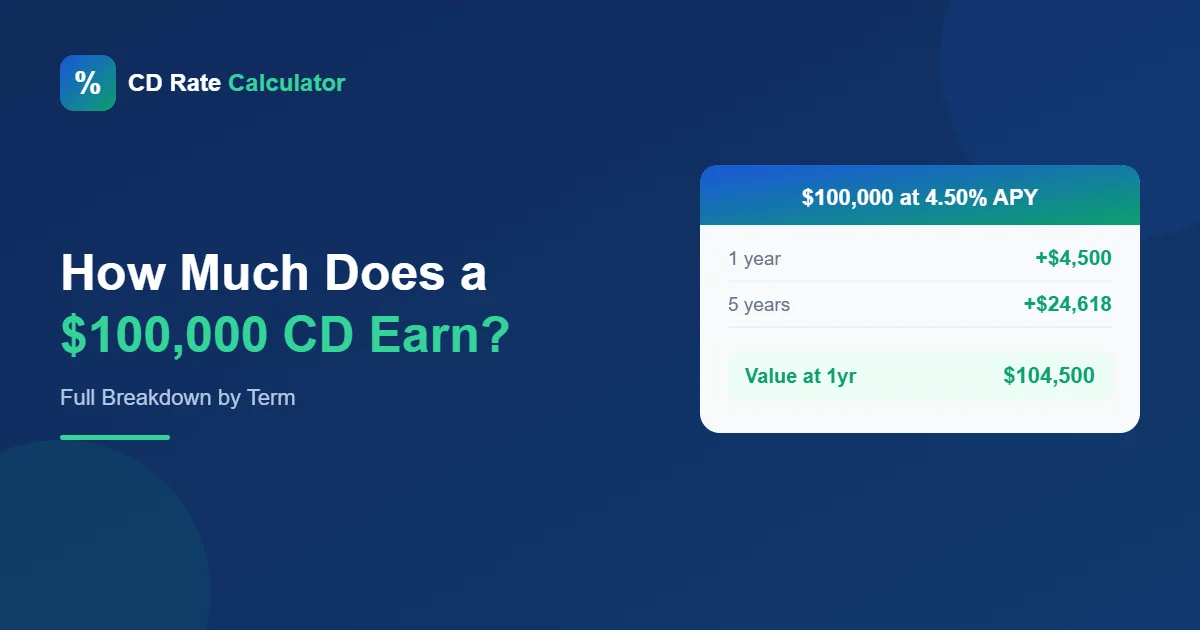
Quick answer: a $100,000 CD at 4.50% APY earns $4,500 in one year, about $9,203 over two years, and roughly $24,618 over five years thanks to compounding. That’s also about $375 a month if you take interest as income. Run your exact rate and term through our free CD rate calculator.
What a $100,000 CD Earns by Term (at 4.50% APY)
| Term | Interest Earned | Value at Maturity |
|---|---|---|
| 3 months | $1,106 | $101,106 |
| 6 months | $2,225 | $102,225 |
| 1 year | $4,500 | $104,500 |
| 2 years | $9,203 | $109,203 |
| 3 years | $14,117 | $114,117 |
| 5 years | $24,618 | $124,618 |
The 5-year figure — $24,618 — is far more than 5 × $4,500 ($22,500). That extra $2,118 is pure compounding, and on six-figure deposits, compounding becomes serious money.
What It Earns by Rate (1-Year Term)
| APY | Interest in 1 Year |
|---|---|
| 4.00% | $4,000 |
| 4.50% | $4,500 |
| 5.00% | $5,000 |
At this size, every 0.10% of APY is worth $100 a year. Shopping rates isn’t optional — the gap between an average bank and a top online bank can be $1,000+ per year on $100,000.
The FDIC Warning Every Large Depositor Needs
FDIC insurance covers $250,000 per depositor, per bank — so a single $100,000 CD is fully insured. But if you already hold other deposits at the same bank, or you’re placing several hundred thousand, you can cross the limit. Solutions: spread across banks, use joint ownership (insured to $500,000), or ask about IntraFi/CDARS networks. Full details in our FDIC insurance guide, and check your coverage with the jumbo CD calculator.
Should a $100,000 CD Be “Jumbo”?
Banks often label $100,000+ CDs as “jumbo” and sometimes offer a small rate premium. But don’t fixate on the jumbo label — a top online bank’s regular CD frequently beats a brick-and-mortar jumbo rate. Compare the actual APY at your deposit size, not the marketing term. See our jumbo CD calculator.
$100,000 as Monthly Income
Many large depositors — especially retirees — take the interest as monthly income instead of compounding it. A $100,000 CD at 4.50% pays roughly $367-375 a month. The trade-off: taking interest out means it doesn’t compound, so total earnings run slightly below the headline APY. See exactly what it pays with our monthly payout calculator.
Don’t Forget Taxes
$4,500 of interest is taxable as ordinary income. In a 24% bracket, that’s about $1,080 to the IRS, leaving roughly $3,420 — plus any state tax. On six figures, the tax bite is meaningful, which is why some large savers prefer an IRA CD (tax-deferred) or Treasury bills (state-tax-free). See how CD interest is taxed.
FAQ
How much does a $100,000 CD make in a year?
About $4,500 at 4.50% APY. At 4.00% it’s $4,000; at 5.00% it’s $5,000 — roughly $100 per year for every 0.10% of rate.
How much does a $100,000 CD earn in 5 years?
Around $24,618 at 4.50% APY — more than 5× the one-year figure because of compounding.
Is a $100,000 CD fully FDIC-insured?
Yes, on its own — the limit is $250,000 per depositor per bank. Just watch your total deposits at that one bank.
How much monthly income does a $100,000 CD provide?
About $367-375 per month at 4.50% APY if you take interest as income rather than compounding it.
See exactly what your $100,000 (or any amount) earns — free CD Rate Calculator.
2 thoughts on “How Much Does a $100,000 CD Earn? (Full Breakdown)”
Comments are closed.