
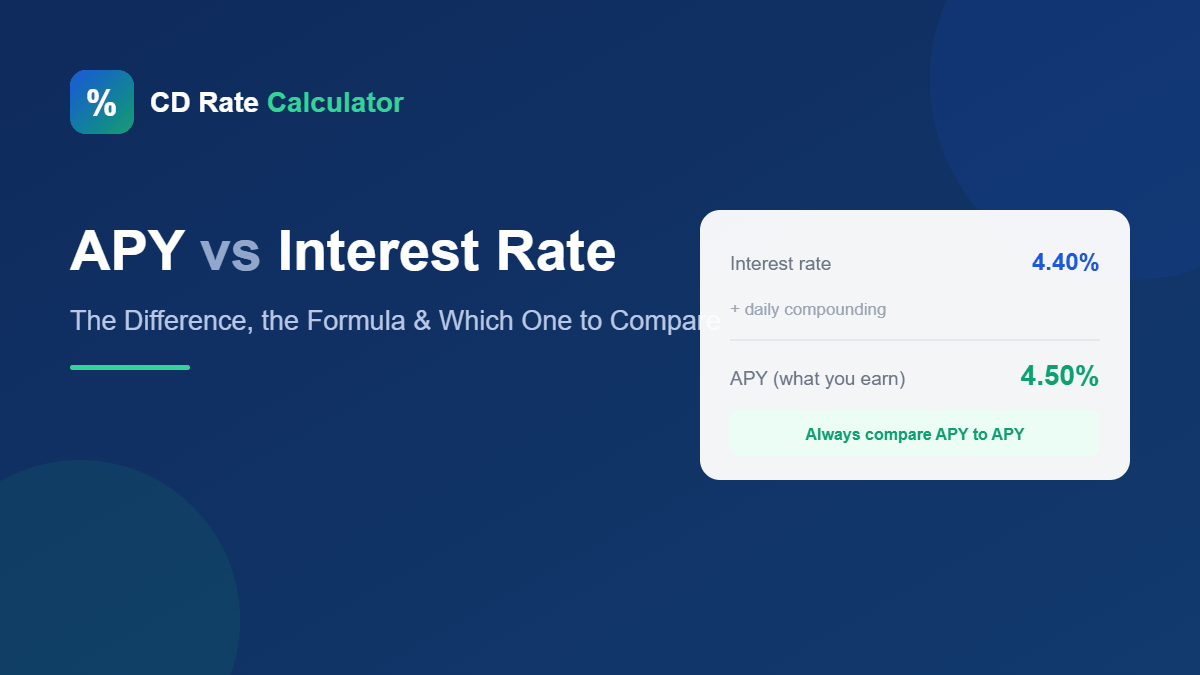
Your CD paperwork shows two different percentages — an “interest rate” of, say, 4.40% and an “APY” of 4.50% — and no explanation of why they don’t match. The difference isn’t a fee or a trick. It’s compounding, and once you see it, every savings product in the market becomes easier to compare.
Quick answer: the interest rate (also called APR or nominal rate) is the base rate before compounding. APY (annual percentage yield) is what you actually earn in a year after compounding. APY is always the number to compare. Convert between them instantly with our APY ⇄ APR converter.
The Difference in One Example
Take a CD with a 4.40% interest rate, compounded daily. Each day, your balance earns 4.40% ÷ 365. But tomorrow’s interest is calculated on today’s slightly bigger balance — interest earning interest. Stack 365 of those tiny compoundings and your money actually grows 4.50% over the year. That realized figure is the APY.
Same CD, two true statements: “the rate is 4.40%” and “you’ll earn 4.50%.” Banks must disclose both; savers only need to act on one.
The Formulas (Both Directions)
Rate → APY: APY = (1 + rate ÷ n)n − 1, where n is compounding periods per year.
APY → Rate: rate = n × ((1 + APY)1/n − 1).
At everyday rates the gap is small but real: a 4.40% rate compounded daily gives 4.498% APY; compounded monthly, 4.490%; compounded once a year, exactly 4.40% (no compounding, no gap). The more frequent the compounding, the wider the spread — our two-way converter handles any frequency.
Why Banks Show the Number They Show
Watch where each number appears. On savings products, banks lead with APY — it’s the bigger number. On loans, they lead with the rate — it’s the smaller one. Neither is dishonest (both are regulated disclosures), but the choice of headline number always flatters the bank. Your defense is one habit: compare savings products APY-to-APY, always.
Does Compounding Frequency Matter When Choosing a CD?
Here’s the liberating part: no — not if you compare APYs. A CD compounding daily at a 4.42% rate and one compounding monthly at a 4.43% rate can both land at the same APY, and they will pay you identically. The APY already absorbs the compounding math. Frequency only matters when a bank quotes you a bare rate without the APY — in which case, convert it before comparing, or use our CD rate calculator, which works directly from APY.
APY vs APR vs Dividend Rate: The Glossary
- Interest rate / nominal rate: the base rate before compounding.
- APR: essentially the same idea, most often used on loans (where it also bundles certain fees).
- APY: the compounded annual yield — the honest comparison number for savings.
- Dividend rate: credit-union language for the interest rate; their APY works exactly the same way.
- Effective annual rate (EAR): textbook synonym for APY.
One Caveat: APY Assumes You Leave the Money Alone
APY presumes interest stays in and compounds. If your CD pays interest out monthly as income, your realized yield lands slightly below the advertised APY — the price of taking the cash early. Details in our guide on withdrawing CD interest.
FAQ
Which is higher, APY or interest rate?
APY — always, whenever compounding happens more than once a year. With annual compounding they’re equal. APY can never be lower than the rate.
Is APY what I actually get paid?
Yes, if you hold the full year and leave interest in. Hold for six months and you earn roughly half the APY’s effect; withdraw interest monthly and you land slightly under it.
Why does my bank quote a 4.40% rate but 4.50% APY?
Daily compounding. The 4.40% is the engine; the 4.50% is the distance actually traveled in a year.
How do I convert APY back to the interest rate?
rate = n × ((1 + APY)^(1/n) − 1). For 4.50% APY compounded daily: 365 × (1.045^(1/365) − 1) ≈ 4.40%. Or skip the math with the converter.
Stop comparing apples to oranges — convert any rate in either direction with the free APY to APR Calculator.