
Money market accounts advertise an APY, credit interest once a month, and quietly recalculate every day in between. If you’ve ever wondered how that monthly deposit is actually computed — or why it doesn’t quite match your own math — this guide walks through the calculation step by step, with real numbers you can check against your own statement.
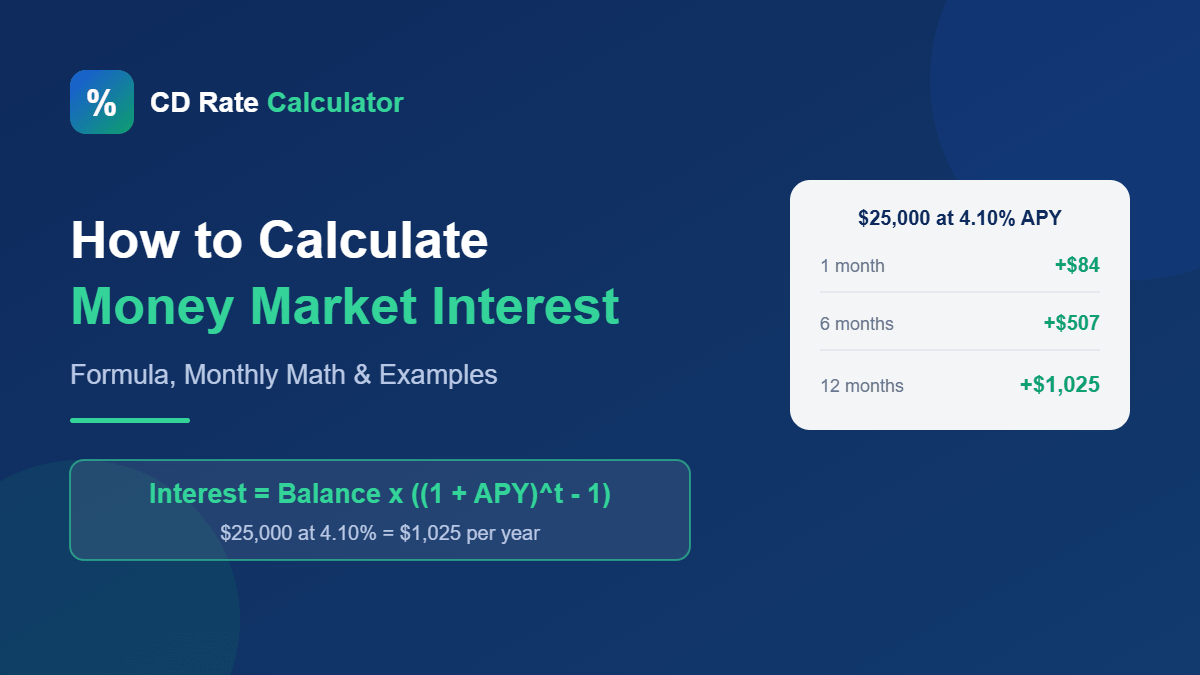
Quick answer: Money Market Interest = Balance × ((1 + APY)^(months ÷ 12) − 1). A $25,000 balance at 4.10% APY earns about $84 in the first month and roughly $1,025 over a year. Skip the hand math with our free Money Market Calculator.
The Money Market Interest Formula
Because banks advertise APY (annual percentage yield), which already includes compounding, the calculation stays clean:
Interest = Balance × ((1 + APY)^t − 1), where t is time in years.
For a $25,000 balance at 4.10% APY:
- 1 month (t = 1/12): $25,000 × 0.00336 = about $84
- 6 months (t = 0.5): $25,000 × 0.02029 = about $507
- 12 months (t = 1): $25,000 × 0.041 = exactly $1,025
The one-year case is the easiest to remember: at exactly one year, interest = balance × APY. Everything shorter or longer needs the exponent — or our Money Market Calculator, which handles any period instantly.
How Banks Actually Compute It: Daily Accrual, Monthly Credit
Your bank doesn’t wait a month to do one calculation. Most MMAs accrue interest daily — each day, your balance earns roughly APR ÷ 365 — and then credit the accumulated total once a month. Two practical consequences:
- Every day’s balance counts. Deposit $5,000 mid-month and it starts earning immediately; you don’t wait for a new cycle.
- Your statement uses the daily-balance method. If your balance moved during the month, the bank computed interest on each day’s actual balance — which is why your own single-balance estimate might differ by a few cents.
This is also why two accounts with the same APY pay the same regardless of compounding frequency — the APY figure already absorbs the difference. If your bank only quotes an interest rate (APR), convert it with our APY to APR Calculator.
Calculating With Tiered Rates

Many money market accounts pay different rates at different balance levels — say, 1.0% on the first $10,000 and 4.25% above it. Calculate each slice separately:
On a $30,000 balance with that structure: ($10,000 × 1.0%) + ($20,000 × 4.25%) = $100 + $850 = $950 a year — an effective rate of just 3.17%, not the advertised 4.25%.
That gap is the most common money market surprise. Before opening an account, always compute the blended rate at your actual balance, then compare it honestly against a flat-rate savings account or CD.
How Fees and Withdrawals Affect Your Earnings
When you calculate money market interest, include any monthly maintenance fees and withdrawals that reduce your average daily balance.
For example, earning $84 in monthly interest may look attractive, but a $10 service fee lowers the net return to $74. Frequent withdrawals can also reduce earnings because money removed from the account stops generating interest immediately. To estimate your true return, calculate interest using the balance held each day, add the daily amounts together, and subtract account fees.
How to Maximize Money Market Interest
You can increase your earnings by maintaining a higher balance, avoiding unnecessary withdrawals, and choosing an account with a competitive APY and no monthly fee. Check whether the advertised rate applies to your entire deposit or only to a specific balance tier.
Since money market rates can change, review your APY regularly and compare it with similar accounts. Even a small rate difference can become meaningful on a large balance, especially when the money remains deposited for several years.
Worked Example: MMA vs Savings vs CD on $25,000
Same deposit, one year, three homes:
- Money market at 4.10% APY: about $1,025 — liquid, rate can change any month
- High-yield savings at 4.00% APY: about $1,000 — liquid, rate floats too
- 12-month CD at 4.50% APY: exactly $1,125 — locked rate, locked money
The CD wins on pure interest, but the $100-125 premium is the price of your access. For emergency money, the liquid options win regardless of the gap; for money with a known future date, the CD usually deserves it. Compare your own numbers with the CD vs High-Yield Savings Calculator.
Why Your Rate Keeps Changing
Money market rates are variable — they track the Federal Reserve’s benchmark rate and your bank’s appetite for deposits. When the Fed cuts, MMA rates typically fall within weeks; CDs, by contrast, keep their locked rate to maturity. This is why any money market calculation is an estimate at today’s rate: accurate for the coming month, increasingly approximate beyond it. Recheck your rate a couple of times a year, and re-shop if your bank quietly drifts below the market.
Taxes on Money Market Interest
Interest from a money market account is ordinary taxable income in the year it’s credited — your bank sends a 1099-INT above $10. Note the cousin confusion: money market funds (brokerage products) may hold government debt whose income is partly state-tax-exempt. Bank MMAs have no such break; every dollar of interest is fully taxable at federal and state level.
FAQ
How much does a money market account pay monthly?
Balance × ((1 + APY)^(1/12) − 1). At 4.10% APY: $10,000 pays about $34 a month, $25,000 about $84, $100,000 about $335.
Is money market interest compounded daily or monthly?
Most banks accrue daily and credit monthly — but it doesn’t change your earnings, because the advertised APY already includes the compounding effect. Compare APYs and ignore the mechanics.
Why doesn’t my statement match my calculation?
Usually one of three reasons: your balance changed during the month (banks use the daily-balance method), your account has rate tiers, or the bank changed the rate mid-month. All three are visible on the statement’s interest detail.
Is a money market account better than a CD?
They solve different problems. MMAs stay liquid with a floating rate; CDs lock both the money and a usually-higher rate. Emergency and short-notice money fits the MMA; dated goals fit CDs — many savers hold both.
Do money market accounts lose money?
A bank money market account cannot lose principal — it’s FDIC-insured up to $250,000. The only “loss” is invisible: if inflation runs above your APY, purchasing power erodes even as the balance grows.
Estimate your exact earnings — any balance, any rate, any period — with the free Money Market Calculator.