
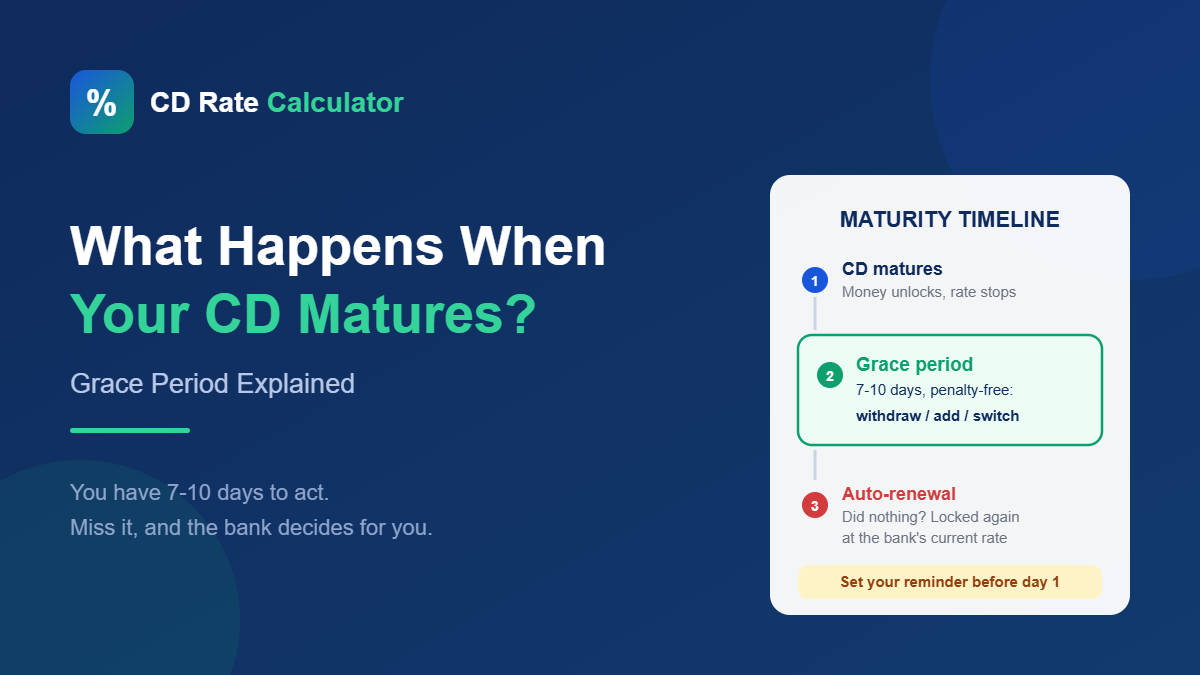
Your CD’s maturity date is circled on the calendar — but what actually happens on that day? Does the money hit your account? Does the CD renew itself? And how long do you have to decide? This guide walks through exactly what happens when a CD matures, day by day, and the one mistake that quietly costs savers the most.
Quick answer: at maturity, your money unlocks and a grace period begins — typically 7 to 10 days — during which you can withdraw, add funds, or move to a new term penalty-free. Do nothing, and most banks automatically renew your CD for the same term at whatever their current rate is. Find your exact maturity date with our free CD Maturity Date Calculator.
The CD Maturity Timeline, Step by Step
A few weeks before maturity: your bank is required to send a maturity notice (mail or email) telling you the date and your options. Don’t skim it — it also states the renewal terms.
On the maturity date: your CD stops earning at its locked rate. The full balance — principal plus all compounded interest — becomes available. Nothing moves automatically to your checking account; the money sits in the CD awaiting your instruction.
The grace period (usually 7-10 days): this is your decision window. Anything you do inside it is penalty-free: withdraw everything, withdraw part, add new money, switch terms, or close the account entirely. Each bank sets its own window — some give 5 days, most give 7-10 — and it’s stated in your CD agreement and maturity notice.
After the grace period: if you did nothing, the CD has already auto-renewed. Your money is locked again for the same term, and withdrawing now means a fresh early withdrawal penalty.
Your Three Options at Maturity
Option 1 — Withdraw the money. Transfer it to checking, savings, or another bank. Zero penalty during grace. Best when you need the cash or when the bank’s renewal rate is poor.
Option 2 — Renew (roll over) the CD. Same bank, same or different term. One warning: ask for the bank’s current best rate, not just the default renewal rate — they’re often different, and the default is rarely the winner.
Option 3 — Move to a better CD. The grace period is a free shopping window. Compare rates across banks, and run the numbers with our CD rate calculator — on a large balance, even 0.5% more APY is real money. This is also the natural moment to start or extend a CD ladder.
The Auto-Renewal Trap

Here’s the mistake that costs savers the most: letting a promotional CD renew automatically.
Say you opened a 12-month promotional CD at a high rate. At maturity, the bank doesn’t renew you at a promotional rate — it renews you into a standard 12-month CD at its regular rate, which can be dramatically lower. The bank is counting on your inattention; “renewal inertia” is a known and profitable pattern in banking.
The fix costs you two minutes: put the maturity date in your phone with a reminder a week early. Our CD Maturity Date Calculator gives you the exact date and counts down the days.
What Happens to Your Interest?
If your CD compounded internally (the default), all the interest is in the balance already — a $10,000 CD at 4.5% matures at $10,450, and the whole amount unlocks together. If you chose monthly interest payouts, you’ve been receiving the interest all along, and only your original principal matures. Either way, remember the tax side: CD interest is taxable in the year it was credited, so a multi-year CD generates a 1099-INT every year — not just at maturity.
Your Pre-Maturity Checklist
- Two weeks out: confirm the maturity date and read the bank’s maturity notice.
- One week out: check current CD rates at 3-4 banks, including online banks — not just your own.
- Decide: need the money? Withdraw. Don’t need it? Pick the best rate and term available anywhere.
- During grace: execute the move. Transfers between banks take 1-3 business days — start early in the window.
- Confirm: make sure the old CD shows closed (or renewed on your chosen terms), and diarize the next maturity date immediately.
Missed the Grace Period? Here’s the Damage
If the CD auto-renewed and you need the money, you’re back to the early withdrawal penalty — typically 3 to 12 months of interest depending on the term. Breaking a just-renewed CD in its first days often means the penalty comes out of your principal, since no new interest has accrued yet. Before acting, calculate the exact cost with our CD Early Withdrawal Penalty Calculator — and read our full guide on CD early withdrawal penalties for ways to soften the blow, including simply asking the bank to reverse a very recent auto-renewal. Many will, once, for a polite customer.
FAQ
Does a CD automatically renew?
At most banks, yes — same term, current standard rate — unless you act during the grace period. A few banks instead move matured funds to a linked savings account; your CD agreement says which.
How long is the grace period after a CD matures?
Typically 7 to 10 calendar days, though it ranges from about 5 to 14 depending on the bank. The clock starts on the maturity date, and weekends count.
Can I add money to my CD when it matures?
Yes — the grace period is the one time you can. Add funds and renew, and the new total locks in for the next term.
Do I keep earning interest during the grace period?
It varies. Some banks pay no interest during grace; others accrue at a low default rate. Either way, it’s days, not months — the bigger money is in choosing the right next home for the funds.
How do I find out when my CD matures?
Check your account statement, the original CD receipt, or your bank’s app. Or enter your opening date and term into our CD Maturity Date Calculator — it gives the exact date plus a day countdown.
What happens if the bank fails before my CD matures?
If the bank is FDIC-insured (or the credit union NCUA-insured) and you’re within the $250,000 limit, your principal and accrued interest are protected. Typically another bank assumes your CD or you’re paid out — you don’t lose your money.
Never let a CD renew blindly again — check your exact maturity date with the free CD Maturity Date Calculator and set your reminder today.