
Your offer letter says $65,000 — but what actually lands in your bank account every two weeks? Figuring out your paycheck from salary means walking through five deductions in the right order. This guide does exactly that, with real numbers at every step, so you can predict your take-home pay before the first pay stub ever arrives.
Quick answer: Take-home pay = salary − pre-tax contributions − federal income tax − Social Security (6.2%) − Medicare (1.45%) − state tax. For a typical $65,000 single earner, that’s roughly $1,880 per bi-weekly paycheck. Get your exact estimate in seconds with our free Paycheck Calculator.
Step 1: Start With Gross Pay Per Period
Divide your annual salary by your number of pay periods:
- Weekly: 52 paychecks — $65,000 ÷ 52 = $1,250
- Bi-weekly: 26 paychecks — $65,000 ÷ 26 = $2,500
- Semi-monthly: 24 paychecks — $65,000 ÷ 24 = $2,708
- Monthly: 12 paychecks — $65,000 ÷ 12 = $5,417
That’s your gross pay — the number everything else gets subtracted from. Note the bi-weekly vs semi-monthly difference: bi-weekly means two months a year you get a third “bonus” paycheck.
Step 2: Subtract Pre-Tax Contributions

401(k) contributions, HSA deposits, and most health insurance premiums come out before taxes are calculated. Contributing 5% to a 401(k) on $65,000 removes $3,250 — but because it’s pre-tax, it only shrinks your paycheck by roughly $2,400 after the tax savings. This is why pre-tax saving is the cheapest saving there is. (Model your retirement account with our 401(k) Calculator with Match.)
Step 3: Federal Income Tax — and the Bracket Myth
Federal tax is where most people overestimate. Two things to know:
First, you don’t pay tax on everything. The standard deduction (about $15,000 for single filers) comes off the top. On $65,000 with a $3,250 401(k) contribution, only about $46,750 is taxable.
Second, brackets are marginal. Landing “in the 22% bracket” does NOT mean you pay 22% on everything — you pay 10% on the first slice, 12% on the next, and 22% only on the part above the threshold. Our example earner pays about $5,370 in federal tax — an effective rate of just 8.3% of gross salary, not 22%.
Step 4: FICA — Social Security and Medicare
These are flat and unavoidable:
- Social Security: 6.2% of gross wages (up to an annual cap of about $176,000)
- Medicare: 1.45% of all wages
On $65,000, that’s $4,030 + $943 = about $4,973 per year. Your employer pays an equal amount on top — one reason hiring you costs more than your salary.
Step 5: State (and Local) Income Tax
This varies from zero (Texas, Florida, Washington, Tennessee, and several others) to over 10% in the highest-tax states. At a typical 4% state rate, our example pays about $2,470. Some cities add local income tax on top — check your locality if you’re unsure why your stub has an extra line.
The Full Example, All Together
$65,000 salary, single filer, 5% 401(k), 4% state tax:
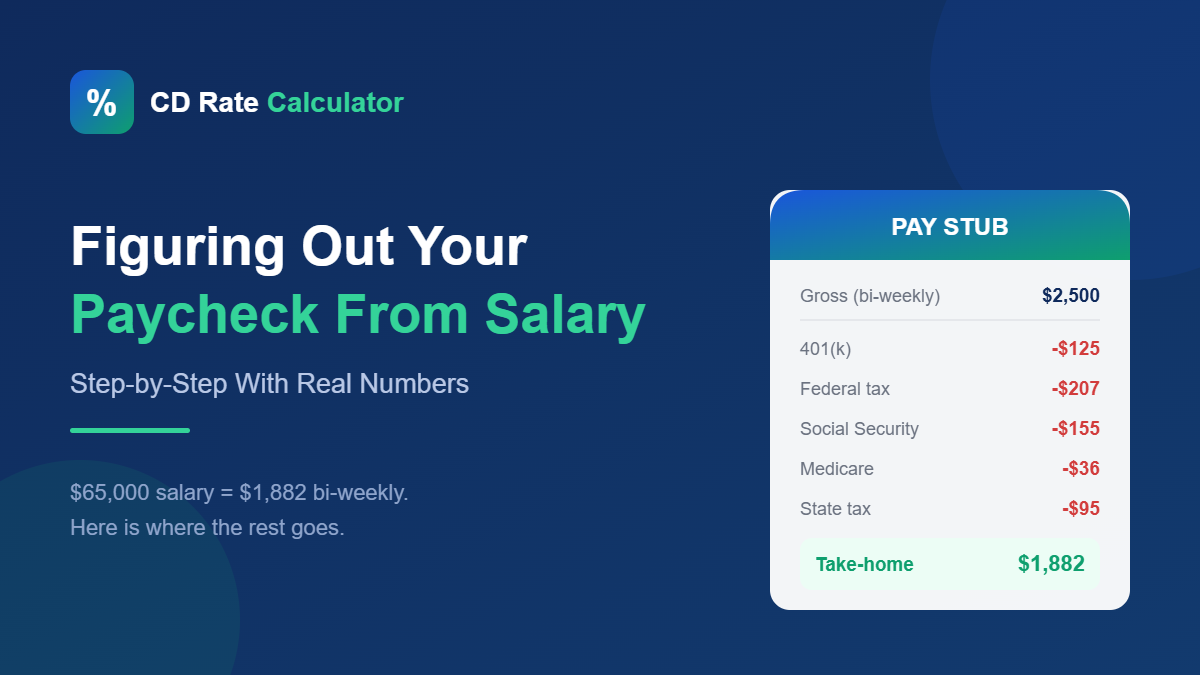
| Line | Annual | Per Bi-Weekly Check |
| Gross salary | $65,000 | $2,500 |
| 401(k) (5%, pre-tax) | −$3,250 | −$125 |
| Federal income tax | −$5,371 | −$207 |
| Social Security (6.2%) | −$4,030 | −$155 |
| Medicare (1.45%) | −$943 | −$36 |
| State tax (4%) | −$2,470 | −$95 |
| Take-home pay | $48,936 | $1,882 |
So a $65,000 salary becomes about $1,882 every two weeks — roughly 75% of gross. That 75% figure is a handy rule of thumb, but it swings with your state, filing status, and benefits, so run your own numbers through the Paycheck Calculator.
Why Your Actual Paycheck May Differ
- W-4 settings — extra withholding or dependents change the federal line.
- Benefits premiums — health, dental, and vision come out of each check.
- Bonuses and overtime — taxed at the same rates but withheld more aggressively upfront (working extra hours? See our Overtime Pay Calculator).
- Mid-year raises — withholding tables adjust, and your new rate applies only to remaining checks.
How to Take Home More of Your Salary
- Fix over-withholding. A $3,000 tax refund means $250 a month you loaned the IRS for free. Adjust your W-4 to bring it home each payday instead.
- Max the employer 401(k) match — it’s part of your compensation; unclaimed match is a pay cut you volunteered for.
- Use an HSA if eligible — the only account that’s tax-free going in, growing, and coming out (for medical costs).
- Put the difference to work. Once you know your real take-home, build your budget from it — and send the surplus to goals with our Savings Goal Calculator.
FAQ
How much of my paycheck goes to taxes?
For most middle-income earners, total taxes (federal + FICA + state) take 20–30% of gross pay. Our $65,000 example loses about 19.7% to taxes plus 5% to voluntary 401(k) savings.
Why is my first paycheck smaller than expected?
Usually a partial pay period (you started mid-cycle), benefits deductions kicking in, or one-time enrollment items. Compare stub line-items against this guide — the second check is the honest one.
Is overtime taxed at a higher rate?
No — that’s a myth. Overtime dollars are taxed like all other dollars. Big checks get more withheld upfront, but it evens out when you file. Extra hours always mean extra take-home.
Bi-weekly vs semi-monthly — does it change my pay?
Your annual pay is identical; only the slicing differs. Bi-weekly gives 26 smaller checks (with two 3-check months per year); semi-monthly gives 24 slightly larger ones.
How do I figure out my paycheck if I’m hourly?
First convert to an annual figure (hourly rate × hours per week × 52), then follow the same five steps. Our Salary to Hourly Calculator converts in both directions.
Stop guessing what your salary is really worth — enter your numbers into the free Paycheck Calculator and see your take-home pay instantly.