
CDs are simple to understand — until tax season, when a form shows up for interest you may not have even touched yet. Here’s exactly how CD interest is taxed, in plain terms.
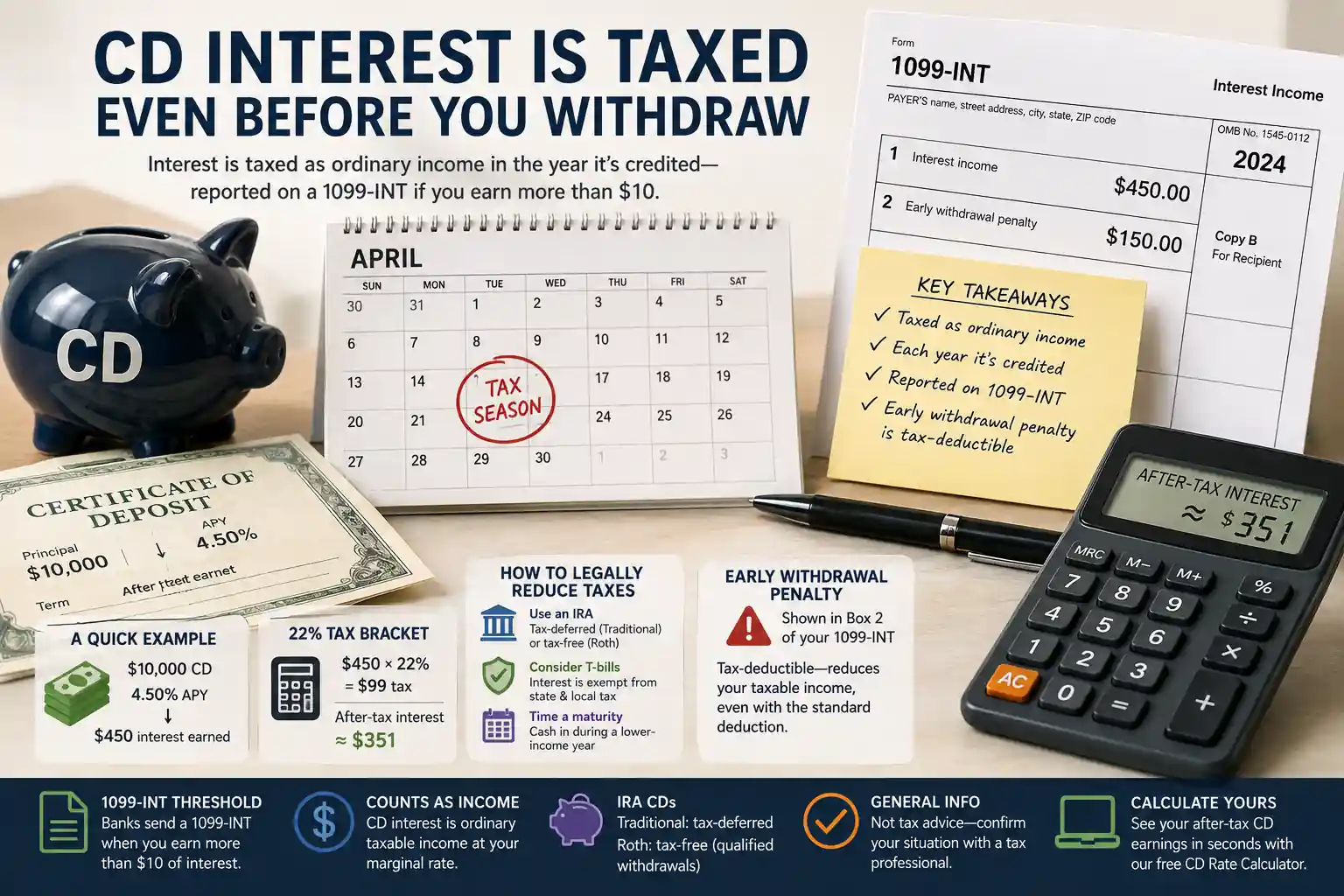
Quick answer: yes — CD interest is taxed as ordinary income in the year it’s credited, even if the CD hasn’t matured and you haven’t withdrawn a cent. Your bank reports it on a 1099-INT for any year you earn more than $10. The exception: CDs held inside an IRA, where taxes are deferred. See the tax difference with our IRA CD calculator.
How CD Interest Is Taxed
The IRS treats CD interest like wages or savings-account interest — ordinary income, taxed at your marginal rate (10% to 37% federally, plus any state tax). There’s no special “investment” rate like long-term capital gains get. A saver in the 22% bracket keeps about 78 cents of every dollar of CD interest.
The Surprise: You Pay Before You Withdraw
Here’s what trips people up. CD interest is taxed in the year it’s credited to your account — not the year you withdraw it. On a multi-year CD that compounds interest internally, you’ll owe tax each year on interest you can’t even access yet without a penalty. A 3-year CD generates a 1099-INT every year, not just at maturity. Some savers use the fact that earned interest can often be withdrawn penalty-free to pull out just enough each year to cover the tax.
Understanding Your 1099-INT
Each January, your bank sends a 1099-INT for the prior year if you earned more than $10 of interest. Two boxes matter for CDs:
- Box 1 — Interest income: the CD interest you must report.
- Box 2 — Early withdrawal penalty: if you broke a CD and paid a penalty, it goes here — and it’s tax-deductible, directly reducing your income even if you take the standard deduction. See our early withdrawal penalty guide.
A Quick Example
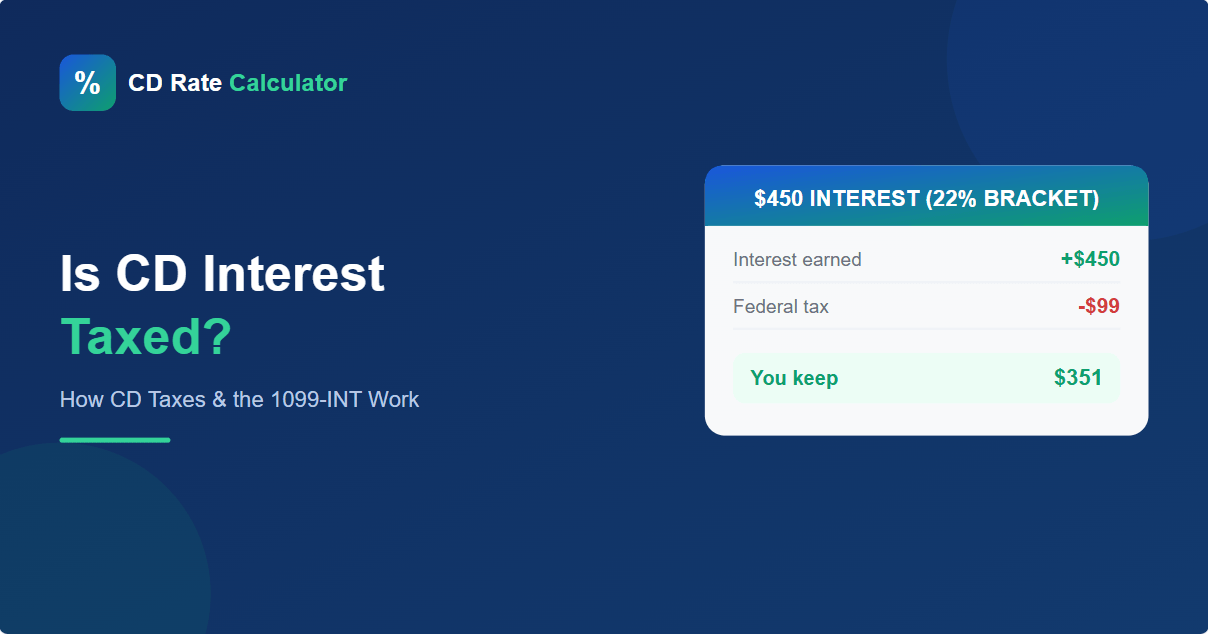
You hold a $10,000 CD at 4.50% APY. It credits about $450 of interest this year. In a 22% bracket, you owe about $99 in federal tax on it (plus any state tax), leaving roughly $351. That’s true even if the CD won’t mature until next year. Calculate your own after-tax earnings — the main CD calculator has a tax-bracket input built in.
How to Legally Reduce CD Taxes
- Hold the CD in an IRA. A traditional IRA defers the tax until withdrawal; a Roth IRA can make qualified withdrawals tax-free. Details in our CD vs IRA guide.
- Consider Treasury bills instead. T-bill interest is exempt from state and local tax — a real edge in high-tax states. Compare with our Treasury bill calculator.
- Time a maturity. A CD maturing in a lower-income year (say, after retirement) may be taxed at a lower bracket.
This is general information, not tax advice — confirm your situation with a tax professional.
FAQ
Do I pay taxes on a CD every year?
Yes, on a compounding multi-year CD — interest is taxed each year it’s credited, even before maturity. A one-year CD is simply taxed the year it matures.
Does CD interest count as income?
Yes — it’s ordinary taxable income at your marginal rate, reported on a 1099-INT and added to your other income for the year.
At what amount does a bank send a 1099-INT?
When you earn more than $10 of interest in a year. Below that, you’re still technically required to report it, but no form is issued.
How are IRA CDs taxed?
Inside a traditional IRA, growth is tax-deferred and taxed on withdrawal; inside a Roth IRA, qualified withdrawals are tax-free. Neither generates a yearly 1099-INT for the CD interest.
Is the early withdrawal penalty tax-deductible?
Yes — it appears in Box 2 of your 1099-INT and reduces your taxable income directly, even with the standard deduction.
See your after-tax CD earnings in seconds — the free CD Rate Calculator has a tax-bracket input.
1 thought on “Is CD Interest Taxed? How CD Taxes Work (1099-INT)”
Comments are closed.