
A CD ladder is one of the few savings strategies that gives you both high interest rates and regular access to your money — without taking any market risk. In this guide, you’ll learn exactly how a CD ladder works, how to build one step by step with real numbers, and the mistakes that quietly cost new ladder builders money.
What Is a CD Ladder?
A CD ladder is a savings strategy where you split your money across several certificates of deposit (CDs) with staggered maturity dates, instead of putting everything into one CD.
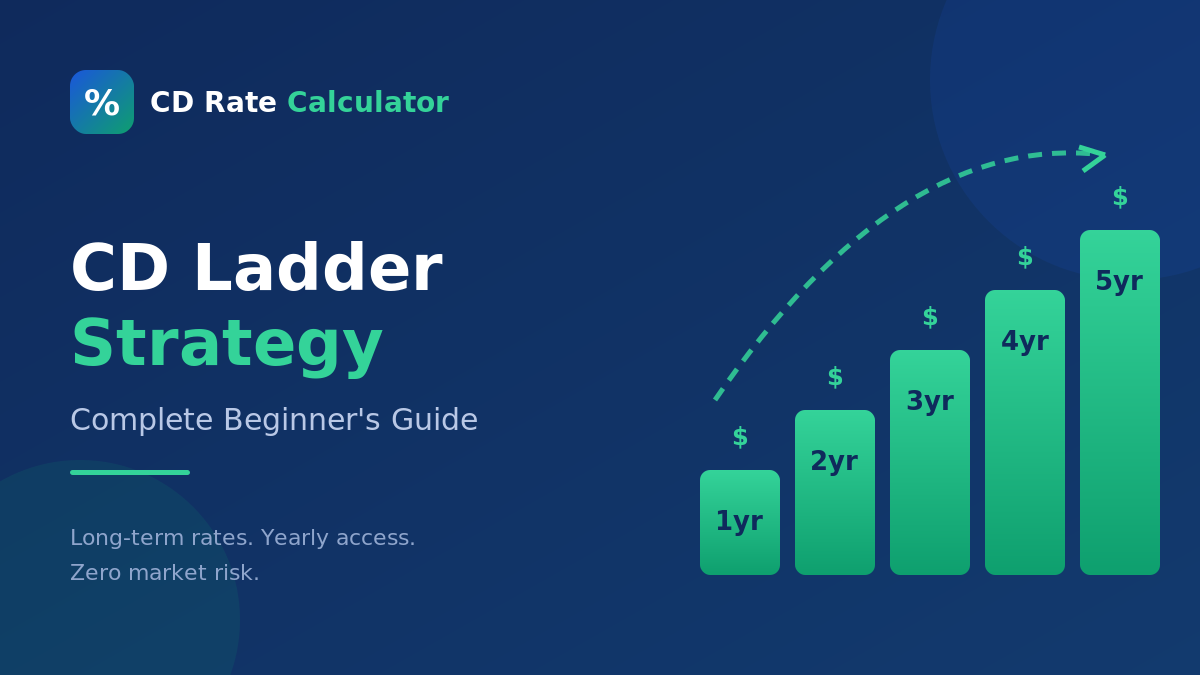
Here’s the classic version: instead of putting $20,000 into a single 5-year CD, you divide it into five $4,000 CDs with terms of 1, 2, 3, 4, and 5 years. Every year, one CD matures and that money becomes available — penalty-free. If you don’t need it, you reinvest it into a new 5-year CD, and the ladder keeps rolling.
The result: part of your savings unlocks every single year, while most of your money earns long-term rates the whole time.
Why Savers Use CD Ladders
The core problem a ladder solves: CDs pay their best rates on longer terms, but locking money for 5 years is scary. What if rates rise? What if you need the cash? A ladder answers both.
- Yearly liquidity. One rung matures every year, so you’re never more than 12 months away from penalty-free access to part of your money.
- Protection if rates rise. When a rung matures, you reinvest it at whatever the new, higher rate is. You’re never fully locked into yesterday’s rates.
- Protection if rates fall. Your longer rungs keep earning the old, higher rate for years after the market drops. Savers who built ladders before rate cuts kept earning top rates long after banks slashed new CD offers.
- Higher average yield. Compared to keeping everything in short 1-year CDs for flexibility, a ladder earns close to long-term rates on most of your balance.
How to Build a CD Ladder: Step by Step
Let’s build the classic 5-rung ladder with $20,000.
Step 1 — Decide your total and your rungs. Divide your amount equally. Five rungs is the classic setup; three rungs (1, 2, 3 years) works fine for smaller amounts.
Step 2 — Open the CDs. Today, you open five CDs at the same time:
- $4,000 in a 1-year CD
- $4,000 in a 2-year CD
- $4,000 in a 3-year CD
- $4,000 in a 4-year CD
- $4,000 in a 5-year CD
You can open them all at one bank for simplicity, or at different banks to chase the best rate for each term.
Step 3 — When each CD matures, reinvest into a new 5-year CD. After year one, your 1-year CD matures. Roll that money into a new 5-year CD. A year later, your original 2-year CD matures — roll it into another 5-year CD. Keep going.
Step 4 — After 4 years, the ladder is “mature.” From this point on, every rung in your ladder is a 5-year CD earning top long-term rates — but one still matures every single year. This is the magic of the strategy: full long-term yield, yearly access.
Want to see the exact numbers for your own amount and rate? Run them through our free CD Ladder Calculator — it shows what every rung will be worth at maturity.
A Real Example With Numbers
Say you build the $20,000 ladder above at an average 4.25% APY:
- Rung 1 (1 year): $4,000 grows to about $4,170
- Rung 2 (2 years): grows to about $4,347
- Rung 3 (3 years): grows to about $4,532
- Rung 4 (4 years): grows to about $4,724
- Rung 5 (5 years): grows to about $4,925
If every rung runs to maturity, your $20,000 becomes roughly $22,698 — about $2,698 in guaranteed interest, with money unlocking every year along the way. Compare that with parking everything in a savings account at a floating rate that can drop any month.
Mini Ladders and Variations
The 5-year ladder isn’t the only option:
- Mini ladder (6-18 months): Split money across 6, 12, and 18-month CDs. Popular when you want access every six months, or when short-term rates are unusually high.
- Uneven ladder: Put more money in the terms with the best rates. Nothing forces equal rungs — the structure is yours to bend.
- Barbell: Half in short CDs, half in long CDs, skipping the middle. Useful when middle-term rates are weak.
Mistakes to Avoid
- Letting CDs auto-renew. When a rung matures, your bank will happily renew it at whatever their current rate is — often far below the best available. Mark every maturity date (our CD Maturity Date Calculator tells you the exact day) and shop rates during the grace period.
- Building a ladder with your emergency fund. Your emergency fund needs same-day access. Keep it in a high-yield savings account and ladder only the money above it — see how the two compare with our CD vs High-Yield Savings Calculator.
- Ignoring early withdrawal penalties. Breaking a rung early usually costs several months of interest. Before you do it, check the real cost with our Early Withdrawal Penalty Calculator.
- Staying loyal to one bank. The gap between an average CD rate and a top online rate is often a full percentage point. Each rung is a fresh chance to shop.
- Forgetting taxes. CD interest is taxed as ordinary income each year it’s credited, even if you don’t touch it. Inside an IRA, that tax is deferred — a meaningful difference over many years.
Is a CD Ladder Right for You?
A CD ladder makes the most sense when you have savings you won’t need immediately but can’t afford to risk — a house down payment a few years away, retirement cash reserves, or money you’re keeping safe on purpose. It’s not designed to beat the stock market; it’s designed to beat savings accounts while guaranteeing you never lose a dollar.
If that matches your situation, start simple: three rungs, equal amounts, best rates you can find. You can always extend the ladder later.
FAQ
How much money do I need to start a CD ladder?
There’s no official minimum — if your bank offers CDs from $500, you can build a 3-rung ladder with $1,500. The strategy works identically at any size.
What happens if I need money between maturity dates?
You break one rung and pay its early withdrawal penalty — but only on that rung, not your whole savings. That’s exactly why laddering beats one big CD.
Should I build a ladder when rates are falling?
Falling rates are actually a strong argument for laddering now: your long rungs lock today’s rates for years. The rungs you reinvest later will earn less, but the ladder smooths the decline instead of exposing all your money to it.
Can I build a CD ladder inside an IRA?
Yes — IRA CDs can be laddered the same way, with the bonus of tax-deferred interest. Just remember IRA withdrawal rules apply on top of CD terms.
Do I have to reinvest when a CD matures, or can I take the money out?
Completely your choice. That’s the built-in flexibility of a ladder: every maturity is a decision point. Take the cash if you need it, reinvest into a new 5-year CD if you don’t, or split the difference. Nothing is locked beyond each rung’s own term.
Is a CD ladder better than a bond ladder?
They work on the same principle, but CDs are simpler and FDIC-insured up to $250,000, while bonds can lose value if sold early and require a brokerage account. For most everyday savers, a CD ladder is the easier, safer version. Bond ladders (especially Treasury ladders) make more sense for larger amounts or when you want state-tax-free interest.
Can I set up a whole CD ladder at one bank, or should I use different banks?
One bank is simpler — a single login and everything matures in one place. Multiple banks almost always earn more, because no single bank has the best rate for every term. A practical middle path: start the ladder at one good online bank, then shop each rung separately as it matures and move it wherever the rate is best.
Ready to plan your own ladder? Try the free CD Ladder Calculator and see exactly what each rung will earn.