
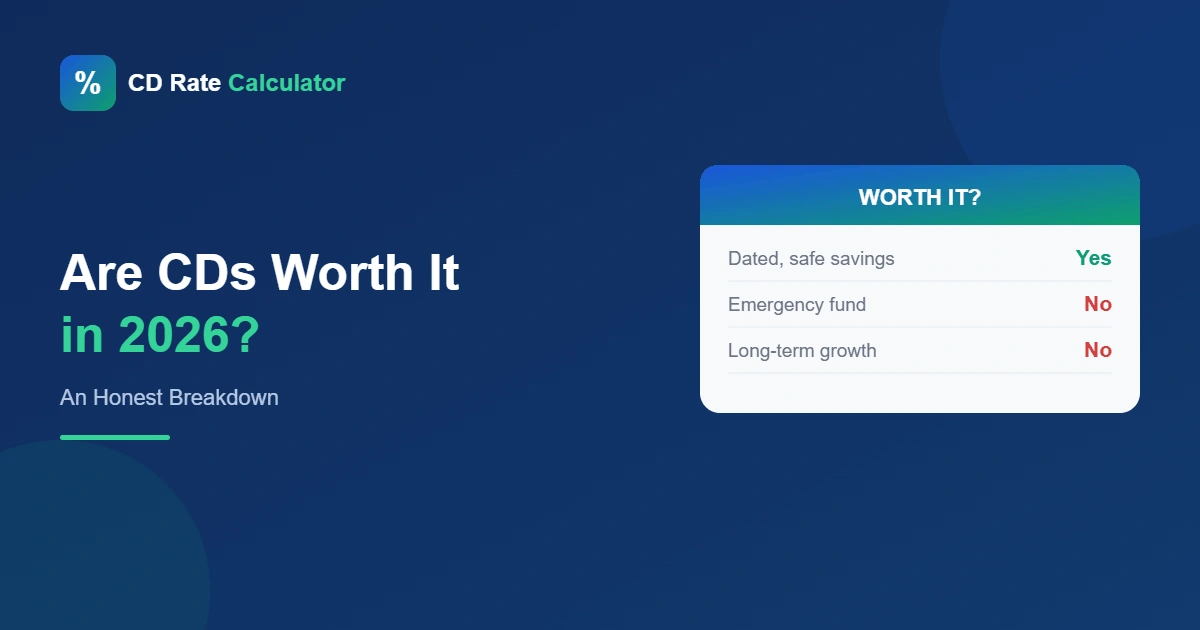
“Are CDs even worth it?” is a fair question — and the honest answer isn’t yes or no, it’s “for what?” A CD is a tool, and like any tool it’s excellent for some jobs and wrong for others. Here’s the balanced breakdown.
Quick answer: yes, a CD is worth it for money you won’t need for a set period and can’t afford to risk — with mid-4% rates in 2026, it beats most savings accounts while guaranteeing your principal. It’s not worth it for emergency money (too locked) or long-term wealth building (investments historically grow faster). See what today’s rates earn on your deposit with our free CD rate calculator.
The Case For CDs
- Guaranteed, risk-free return. Your rate is locked and your principal is FDIC-insured up to $250,000. No market can take it away.
- Better than most savings accounts, especially when rates are falling — your CD keeps its rate while savings rates drop.
- Discipline built in. The penalty for early withdrawal keeps you from spending money earmarked for a goal.
- Predictable. You know the exact dollar amount you’ll have on the exact date — priceless for planning.
The Case Against CDs
- Your money is locked. Need it early and you pay a penalty. This alone disqualifies emergency money.
- Inflation risk. If a CD pays 4.5% and inflation runs 3%, your real gain is only about 1.5%. A CD protects money more than it grows it.
- Opportunity cost. Over long periods, diversified investments have historically returned far more — a CD is safety, not growth.
- Taxes. Interest is taxed as ordinary income yearly. See how CD taxes work.
When a CD Is Worth It (and When It Isn’t)
| Situation | CD Worth It? |
|---|---|
| Money for a house/car/wedding in 1-3 years | Yes — ideal fit |
| Emergency fund | No — keep it liquid in savings |
| Retirement money, decades away | Usually no — investments grow more |
| Safe slice of a retiree’s portfolio | Yes — especially an IRA CD |
| Money you might need any day | No — or use a no-penalty CD |
| Cash earning nothing in checking | Yes — almost always better |
The Most Important Question Before Opening a CD
Before opening a CD, ask yourself exactly when you will need the money and what could cause that timeline to change.
A CD works best when the deposit is tied to a specific, predictable goal, such as a home down payment, tuition bill, major purchase, or planned expense within the next few years.
The interest rate matters, but liquidity matters just as much, because even a strong return can lose its appeal if an unexpected withdrawal triggers a penalty.
Review the maturity date, early withdrawal terms, minimum deposit requirement, compounding schedule, and whether the account renews automatically.
It is also smart to compare the CD’s annual percentage yield with high-yield savings accounts, Treasury securities, and no-penalty CDs.
The best CD is not necessarily the one offering the highest advertised rate; it is the one that protects your savings, matches your financial timeline, and allows you to reach your goal without creating unnecessary restrictions.
The Honest Middle Ground
Most people don’t face an all-or-nothing choice. Keep your emergency fund liquid (see our emergency fund guide), invest your long-term retirement money, and use CDs for the in-between: safe money with a known timeline. Can’t decide on a term? A CD ladder gives you higher long-term rates while freeing up cash every year — often the best answer to “are CDs worth it.”
FAQ
Are CDs worth it in 2026?
For safe money with a set timeline, yes — mid-4% rates beat most savings accounts and guarantee your principal. For emergencies or long-term growth, other options fit better.
Are CDs better than a high-yield savings account?
For money with a known date, usually yes — the locked rate is higher and protected from cuts. For flexible money, savings wins. Compare with our CD vs savings calculator.
What’s the downside of a CD?
Your money is locked until maturity, early withdrawal carries a penalty, and returns won’t match long-term investing. Inflation can also erode real returns.
Are CDs a good investment?
They’re better described as a savings tool than an investment. They preserve and modestly grow money safely, but they’re not designed to build wealth like stocks over decades.
See what a CD would actually earn you at today’s rates — free CD Rate Calculator.