
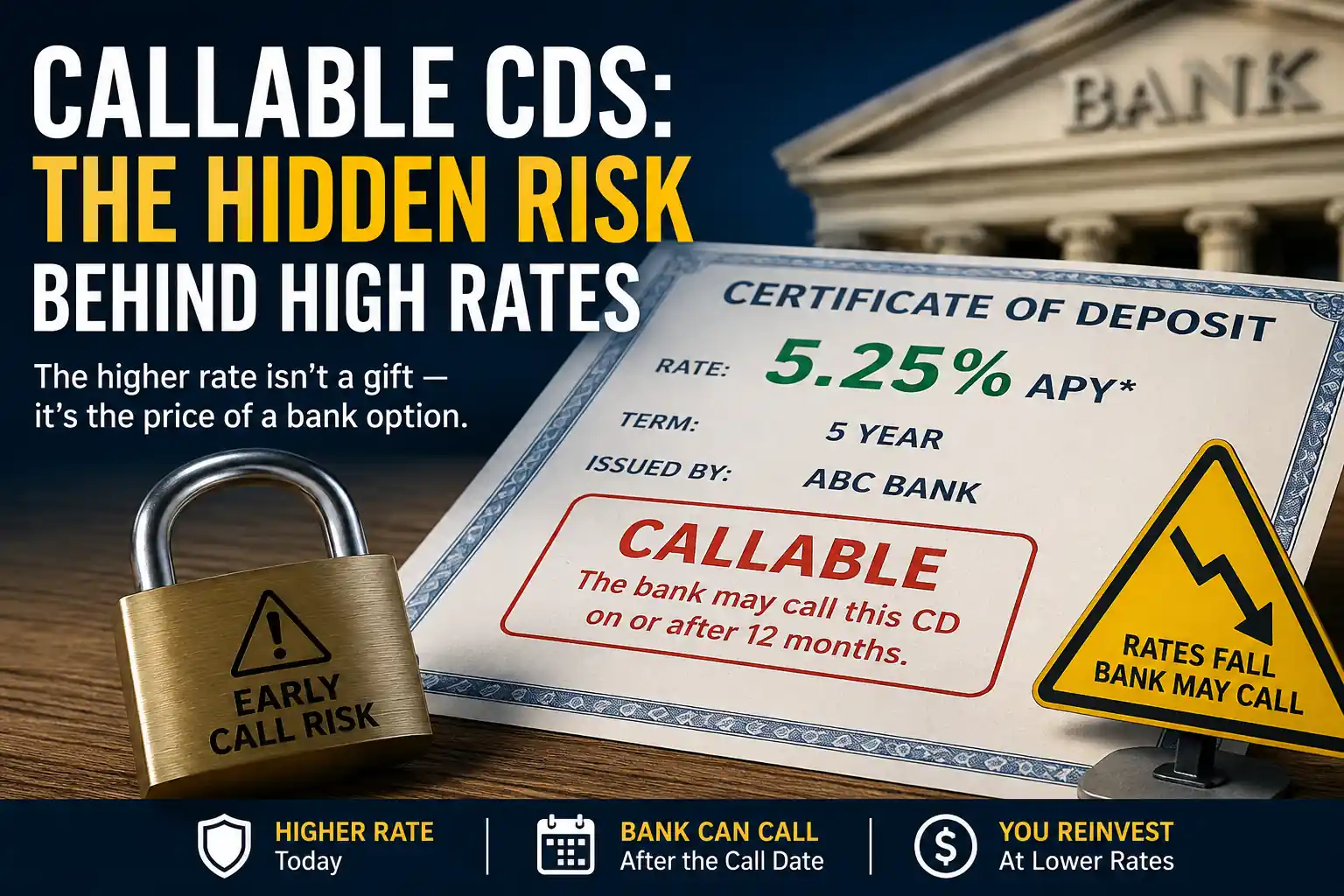
You spot a CD paying noticeably more than everything else on the market. Before you jump, check one word in the fine print: “callable.” It’s the feature that explains the extra rate — and the catch that comes with it.
Quick answer: a callable CD lets the bank close the CD early — “call” it — usually if interest rates fall. You get your principal and earned interest back, but you lose the high rate you were counting on, right when reinvesting means accepting lower rates. The higher headline rate is compensation for handing the bank that option. Model a normal long-term CD with our 10-year CD calculator.
How a Callable CD Works
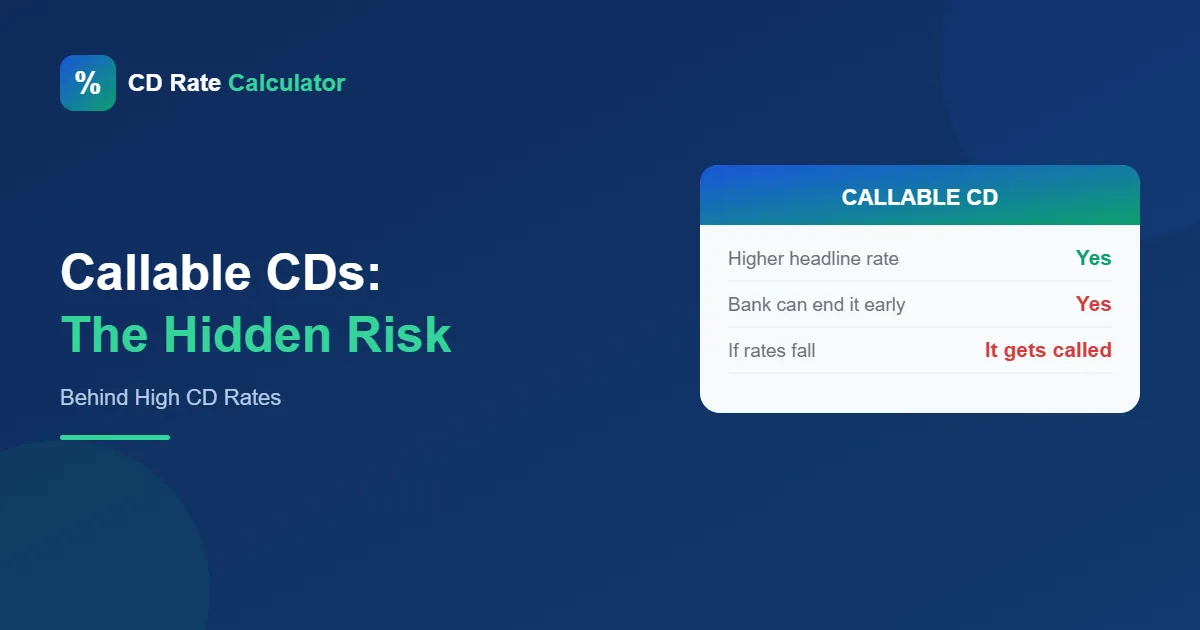
A callable CD has a call date (or several) — the earliest point the bank can end it, often six months or a year in. If market rates drop below your CD’s rate, the bank exercises its option: it pays you back in full and stops the high interest, then re-lends at the new lower rates. If rates rise or hold, the bank simply leaves your CD alone — you keep the rate, but you don’t benefit from the increase either. Heads the bank wins, tails you don’t.
Why the Rate Looks So Good
That premium isn’t generosity — it’s the price of the call option you’re selling to the bank. You’re being paid a little extra to accept the risk that your best-case scenario (rates fall, you keep a great rate for years) is exactly the scenario the bank will cancel. Understanding this flips the appeal: the high rate is a warning label, not a gift.
Callable vs Non-Callable CDs
| Callable CD | Standard (non-callable) CD | |
|---|---|---|
| Who can end it early | The bank (at call dates) | Only you (with a penalty) |
| Rate | Higher headline rate | Standard rate |
| If rates fall | Bank likely calls it — you lose the rate | You keep your locked rate — the win |
| Best for | Rate speculators who understand the trade | Most savers who want certainty |
How to Spot (and Avoid) a Callable CD
Callable CDs show up most in the brokered CD market. Before buying, look for the words “callable,” a stated “call date,” or “call protection.” If the term sheet doesn’t say non-callable, assume it may be callable and ask. For most savers seeking the whole point of a CD — a locked, dependable rate — a standard non-callable CD is the right choice. If you want a genuinely long lock without the call risk, compare terms with our 5-year and 10-year CD calculators, and read our guide on how CDs work.
FAQ
What is a callable CD in simple terms?
A CD the bank can cancel early if it’s in the bank’s interest — typically when rates fall. You get your money back, but lose the attractive rate.
Do I lose money on a callable CD if it’s called?
No — you keep your principal and all interest earned up to the call date. What you lose is the future high rate, forcing you to reinvest at lower rates.
Are callable CDs FDIC-insured?
Yes, if issued by an FDIC bank — the call feature doesn’t affect insurance. It’s a rate risk, not a safety risk.
Why would anyone buy a callable CD?
For the higher rate, betting that rates stay flat or rise so the CD is never called. It’s a calculated bet, not a mistake — as long as you understand the trade.
Want a straightforward, non-callable long-term CD? See what it earns with the free 10-Year CD Calculator.