
You see the word on every CD statement — “maturity date,” “matures on,” “at maturity” — but banks rarely stop to explain it. Here’s the plain-English meaning, in one minute.
Quick answer: a CD “matures” when its fixed term ends. On that day, the agreement you made with the bank is complete: your money — the original deposit plus all the interest it earned — unlocks and becomes fully available to withdraw, reinvest, or move. Nothing is lost; the lock simply comes off. See your exact maturity value with our free CD rate calculator.
Maturity, in One Sentence
When you open a CD, you agree to leave your money untouched for a set period — the term — in exchange for a locked, guaranteed rate. “Maturity” is simply the finish line of that period. A 12-month CD opened on July 1 matures on July 1 the following year. That’s the whole concept.
What Happens on the Maturity Date
Three things happen the moment a CD matures:
- The rate lock ends. Your CD stops earning its guaranteed rate.
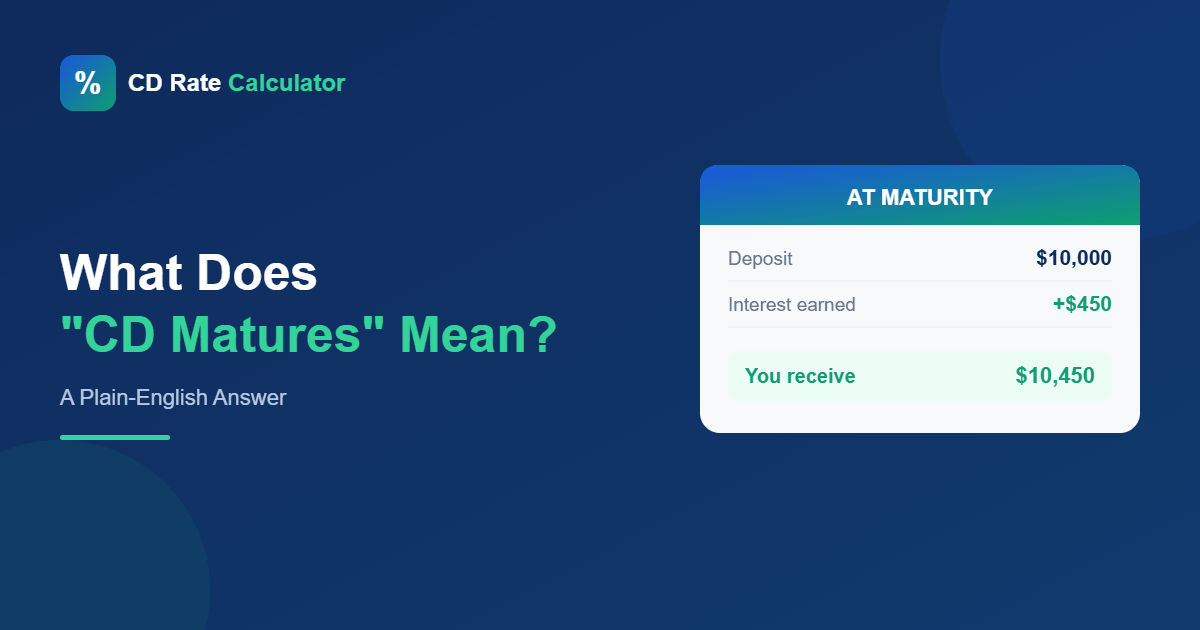
- Your money unlocks. The full balance — deposit plus every dollar of compounded interest — is now available. A $10,000 CD at 4.50% APY matures at $10,450.
- A grace period begins. You get about 7-10 days to decide what to do next, penalty-free.
Importantly, the money doesn’t automatically land in your checking account — it sits in the matured CD awaiting your instruction. Miss the grace period and most banks automatically renew it into a new term.
Where to Find Your Maturity Date
It’s on your original CD receipt, your account statement, and usually your bank’s app. Don’t have it handy? Enter your opening date and term into our CD Maturity Date Calculator — it gives the exact date plus a countdown.
Maturity Date vs. Maturity Value
These two terms sound similar, but they mean different things. The maturity date is the day your CD term ends. The maturity value is the total amount you receive when the CD reaches that date.
Your maturity value may include:
- Your original deposit.
- All interest earned during the term.
- Any interest that was added back into the account through compounding.
- Additional deposits, if your CD allows them.
For example, if you deposit $5,000 into a one-year CD at a fixed APY, the maturity value will be your $5,000 deposit plus the interest earned during that year. Your bank statement or CD calculator can show the exact amount.
How to Prepare for CD Maturity
A little preparation can help you avoid an unwanted renewal or a lower interest rate. Start reviewing the account before the maturity date rather than waiting until the last day.
Use this simple preparation plan:
- Write down the maturity date: Add it to your calendar as soon as you open the CD.
- Set an early reminder: Create alerts for 30 days, 14 days, and 7 days before maturity.
- Check your financial plans: Decide whether you need the money for bills, a purchase, or an emergency fund.
- Compare current rates: Look at other CDs and high-yield savings accounts.
- Read the renewal notice: Confirm the new APY, term, and early-withdrawal penalty.
- Contact the bank early: Ask how to stop automatic renewal or change your instructions.
- Save your confirmation: Keep proof of your transfer or renewal request.
Can the Maturity Date Change?
The maturity date is usually fixed when you open the CD, but it can sometimes be affected by weekends, holidays, or special account terms. If the scheduled date falls on a non-business day, the bank may process the transaction on the next business day.
That does not always mean you receive extra time to make a decision. Your bank’s disclosure explains how it handles weekends, holidays, and grace-period deadlines. Check the exact dates instead of relying on a general rule.
Maturity vs Early Withdrawal
Reaching maturity is the reward for waiting — no penalty, full interest. Withdrawing before maturity is the opposite: it triggers an early withdrawal penalty of several months’ interest. That contrast is the entire reason “maturity” matters — it’s the date the money becomes truly yours again, cost-free.

FAQ
What does it mean when a CD reaches maturity?
Its term is complete. The money unlocks — deposit plus interest — and you can withdraw or reinvest it penalty-free during the grace period that follows.
Do I get my money automatically when a CD matures?
No. The money becomes available but stays in the CD until you act. If you do nothing, most banks auto-renew it into a new term.
How much is a CD worth at maturity?
Your deposit plus all compounded interest. For example, $10,000 at 4.50% APY for one year matures at $10,450. Try your own numbers in the CD calculator.
What should I do when my CD matures?
Decide during the grace period: withdraw it, renew at the best current rate, or move it to a better CD. See our full guide on what happens when a CD matures.
Does a CD mature at the end of the day?
Usually, the bank processes the CD according to its account terms and business-day procedures. Check your statement or contact the bank if you need access on a specific date.
Does interest stop on the maturity date?
The original fixed-rate term ends at maturity. After that point, the account may earn a different rate or renew into a new CD, depending on the bank’s rules.
Can I add money when my CD matures?
Many banks allow you to add money during the grace period, but the rules vary. Ask whether the new CD accepts additional deposits before renewing.
Is the maturity date the same as the interest-payment date?
Not always. Some CDs pay interest monthly, quarterly, or annually, while the principal becomes available at maturity. Review your account details to see how payments work.
What if I miss the maturity deadline?
Contact the bank immediately. If the CD has recently renewed, the bank may explain whether it can reverse the renewal, but it is not required to do so.
Can I withdraw only part of the money at maturity?
Some banks allow partial withdrawals during the grace period, while others require you to withdraw or renew the entire balance. Confirm the policy before opening the CD.
What is the safest way to track several CDs?
Keep a simple record showing each CD’s opening date, maturity date, APY, balance, renewal instructions, and bank contact information. Set a separate calendar reminder for every account.
See exactly what your CD will be worth at maturity — free CD Rate Calculator.