
A mini CD ladder offers planned cash access without requiring several CDs to reach maturity together. Its regular maturities can support future spending, while each account promises a fixed return under its stated terms. That creates predictable access at scheduled dates, not unrestricted daily withdrawals.
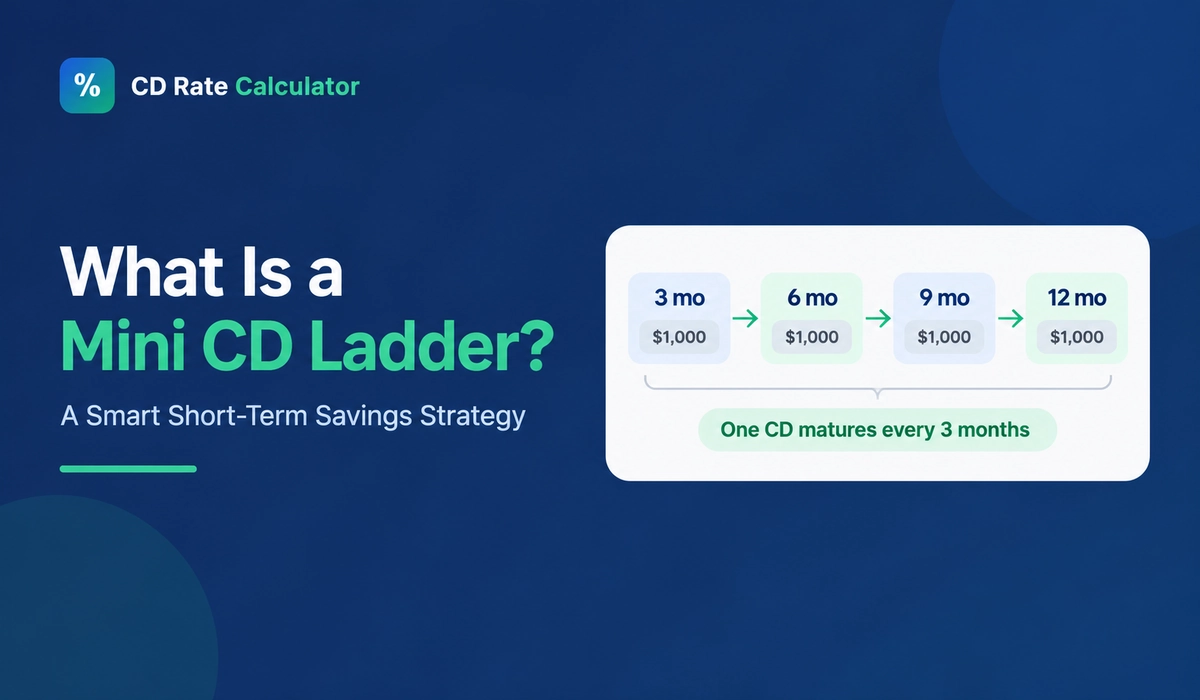
Quick Answer: A mini CD ladder is a savings strategy that splits your money into short-term certificates of deposit, usually with 3-, 6-, 9-, and 12-month terms. For example, you can divide $4,000 into four CDs of $1,000 each, allowing one CD to mature every three months during the first year. When each CD matures, you can withdraw the money or reinvest it at the current interest rate. This approach helps you earn fixed interest while keeping portions of your savings available at regular intervals.
Before opening accounts, connect the ladder to your savings goals through careful time horizon planning. Keep a separate cash reserve for unexpected bills. The useful question is not simply how much interest you might earn, but how much money you can afford to leave untouched between maturity dates.
What Is a Mini CD Ladder?
A mini CD ladder is a short-term savings strategy that divides money among certificates of deposit with different maturity dates, commonly 3, 6, 9, and 12 months. This allows portions of the money to become available at regular intervals, while each CD earns its agreed interest rate until maturity.
The staggered arrangement matters more than the number of accounts. Rather than locking the entire principal in one deposit account, a saver chooses several fixed terms. Each maturity provides a fresh choice: use the funds, keep them in savings, or buy another CD.
The appeal is predictability, not unlimited liquidity. Expected interest earnings can be estimated from the deposit, APY, and term, but actual available rates vary between banks. A mini ladder is useful when the saver knows the earliest date each portion of money might be needed.
How Does a Mini CD Ladder Differ From a Traditional Ladder?
A mini CD ladder differs from a traditional ladder mainly in its shorter horizon and more frequent opportunities to access cash. The underlying practice of dividing deposits across maturity dates stays the same.
If you want a traditional annual maturity schedule instead, read our guide on how to build a CD ladder with a five-year example.
A typical longer structure has several rungs, such as CDs ranging from one-year terms through a five-year CD. That produces an annual maturity pattern when the initial terms are spaced by a year. A mini version changes the frequency of those decisions from years to months.
The central trade-off is between flexibility and committing to a long-term rate. Shorter commitments allow an earlier response if rates or financial needs change, but they can also force reinvestment at lower future rates. Neither structure automatically pays more: compare actual offers instead of assuming longer is better.
How Does a Mini CD Ladder Work Month by Month?
A mini CD ladder works by opening CDs whose terms end at different points, then deciding what to do with each deposit when it matures. A four-rung example starts with these short maturities:
| CD rung | Initial term | First access date |
|---|---|---|
| First | 3-month CD | After 3 months |
| Second | 6-month CD | After 6 months |
| Third | 9-month CD | After 9 months |
| Fourth | 12-month CD | After 12 months |
A quarterly mini ladder is different from a monthly CD ladder, which is designed to make a CD mature every month once the schedule is established.
That arrangement creates a quarterly schedule during the first year: a maturity arrives every three months. After the first deposit becomes available, the saver can spend it or undertake reinvestment. The dates stay regularly spaced only if later purchases are chosen to preserve that spacing.
For example, rolling each matured amount into a new 12-month CD can maintain quarterly access after the ladder is established. It does not guarantee an identical yield. New CDs carry whatever rate is available when the rollover is made.
How Do You Build a Mini CD Ladder Step by Step?
You build a mini CD ladder by setting aside money that is not needed immediately, choosing maturity dates, and opening separate certificates. The order matters because an unsuitable term can make the whole plan harder to use.
- Identify the amount in your budget that can remain locked until maturity. Leave urgent expenses outside the ladder.
- Research banks and credit unions, then select terms by checking their APYs, opening requirements, and withdrawal conditions.
- Spread the deposit among separate accounts, choosing amounts based on when you will need the cash.
- Track every due date and set a maturity notification well before the bank’s response window begins.
- Decide whether to renew a matured CD or withdraw its proceeds for a planned expense.
Before placing the deposits, read the account agreement. A renewal may be automatic, and the next rate can differ from the current rate. Revisit the plan when an expense date changes rather than breaking a certificate without checking its penalty.
Which CD Terms and Deposit Amounts Should You Choose?
Choose CD terms based on when each portion of money may be needed, then compare the available annual percentage yield (APY) and minimum deposits. No single maturity pattern fits every saver.
The following published examples illustrate different schedules and deposit sizes; they are not quotes for currently available products.
| Example | Total amount | Deposit per CD | CD terms |
|---|---|---|---|
| Business Insider short ladder | $7,500 | $2,500 each | 3, 6, and 12 months |
| Business Insider longer staggered ladder | $20,000 | $5,000 each | 6, 12, 18-month, and 24-month CDs |
The second example has six-month gaps between maturities. The first has a longer gap from month 6 to month 12, so neither should be described as automatically delivering quarterly withdrawals forever. The examples also show why allocation matters as much as the number of CDs.
After the five stages of building a ladder, a final bank comparison helps catch special conditions. You can use an uneven split when a larger expense falls at one particular maturity, provided every CD satisfies its own funding minimum.
What Are the Benefits of a Mini CD Ladder?
A mini CD ladder’s main benefit is greater planned liquidity than putting every dollar in a single longer-term CD. Money becomes available at different dates without requiring an early break of a certificate.
A staggered schedule can help with expected cash flow, while traditional fixed-rate CDs offer stable returns for their contracted periods. Separating future spending into timed deposits may also support financial discipline, because the money is less convenient to spend before it is due.
A further benefit is how the ladder handles rate uncertainty. Under rising rates, one upcoming maturity creates an opportunity to reinvest at a better offer. Under falling rates, existing CDs continue earning their locked interest until maturity. The overall potential yield, however, is never guaranteed to exceed that of another savings choice.
What Mistakes Should You Avoid With a Mini CD Ladder?
The main mistake with a mini CD ladder is assuming that staggered dates make all the money readily available. A certificate can still impose penalties for early withdrawal, and its terms deserve close attention.
- Before purchase: Estimate the opportunity cost of tying up each deposit. Consider inflation, competing savings yields, and any chance of lost access when a bill arrives sooner than expected.
- During the term: Plan for active management of maturity dates. Understand how taxable interest is treated and review bank notices instead of relying on memory.
- At maturity: Check the grace period and any automatic renewal setting. Compare new rates because reinvestment risk means the replacement CD could earn less than the old one.
The purpose of this review is to prevent avoidable fees and unwanted account terms. A short ladder may reduce the duration of a commitment, but it does not remove the need to manage that commitment carefully.
To avoid losing track of renewal dates, use our CD ladder Excel spreadsheet to organize your short-term deposits and estimated maturity values.
When Does a Mini CD Ladder Make Sense?
A mini CD ladder makes sense when savings support a specific goal and the owner knows approximately when the money will be used. It works particularly well for planned expenses that do not require immediate withdrawals.
Someone preparing for a car purchase or home purchase can align maturity dates with expected payments. A near-term goal with a flexible timeline is easier to coordinate than a bill that might arrive tomorrow. The useful test is whether the expense dates and certificate dates genuinely match.
An emergency fund belongs primarily in an accessible savings account, because emergencies can happen on short notice. Keeping that reserve outside CDs reduces the pressure to redeem a certificate before maturity. A mini ladder should complement emergency savings, not serve as the only source of liquid cash.
How Much Money Do You Need for a Mini CD Ladder?
You need enough money to satisfy the minimum deposit for every certificate, so no universal starting amount applies. Investopedia illustrates five CDs, each requiring $1,000, for $5,000 in initial funding; that is an example, not a standard mini-ladder rule.
Your bank policy determines actual opening requirements. Judge affordability against total savings before committing funds. If the thresholds absorb your liquid buffer, consider fewer CDs or keep more money in savings rather than trying to fill every rung immediately.
How Many CDs Should Be in a Mini CD Ladder?
A mini ladder can contain any practical number of CDs, although Penn Community Bank says three to five is common. Your preferred account count depends on the interval between planned maturity dates.
More accounts may increase flexibility, but also add administration, so find a useful balance. Choose spaced terms that fit your personal preference and leave room for customization. Record each maturity on a calendar before deciding whether another rung adds real value.
Is a Mini CD Ladder Safe?
A mini ladder at an insured bank may qualify for FDIC deposit insurance on its CD balances, subject to insurance rules. Standard federal insurance provides up to $250,000 per depositor, per insured bank, per ownership category.
The FDIC combines deposits held in the same category at the same institution when calculating coverage. This principal protection addresses qualifying bank failure, not the inability to spend locked funds before maturity. For safety, verify the bank’s insurance status and review its withdrawal terms.
Is a Mini CD Ladder Worth It?
A mini ladder may be worth it when access needs match scheduled maturities and fixed interest supports financial goals. Compare market rates through an interest comparison with ordinary savings products.
Its earnings potential must fit your risk tolerance and return expectations. Think about your time horizon and whether liquid alternatives could better handle sudden bills. Make the final bank choice based on all terms, not a headline yield; a useful maturity schedule can matter more than a small difference in advertised interest.
Can You Live Off Mini CD Ladder Interest?
Living on mini ladder interest requires enough capital that the earnings cover living costs without spending principal. Business Insider illustrates a $200,000 1-year CD paying 5% APY, which earns $10,000 over one year.
Even a large balance may generate only modest income relative to a household’s needed annual income. For interest-only cash generation, compare after-tax earnings with your budget. A ladder changes when CDs mature, not the interest rate paid simply because the deposits were split into separate accounts.